Key Takeaways
- Daily reconciliation prevents small discrepancies from becoming month-end surprises
- A standardized chart of accounts is the foundation for portfolio-level comparison
- Automating accounts payable reduces processing cost and eliminates duplicate payments
- A documented close checklist ensures nothing is skipped under deadline pressure
- Connecting labor and accounting data eliminates a major source of manual reconciliation
- Owner reports delivered on a consistent schedule build trust and reduce ad hoc requests
- Variance review before close catches mispostings before they reach the final P&L
Why Accounting Processes Matter More Than Software Alone
Good hotel accounting software accelerates good processes and makes bad processes more visible. Management companies that standardize accounting workflows across their portfolio gain something more valuable than efficiency: they gain comparability. When every property follows the same processes, portfolio-level analysis becomes meaningful rather than a reconciliation exercise.
The seven processes below are not theoretical ideals. They are the workflows that high-performing hotel management company accounting teams actually operate. Each one is achievable with the right combination of process discipline and software support.
The 7 Best Hotel Accounting Processes
- Daily Reconciliation. Reconcile revenue, cash, and bank activity every day. Daily reconciliation catches errors when they are easy to trace and easy to fix. Waiting until month-end to reconcile means debugging a month of transactions instead of one day. The daily reconciliation process should compare PMS revenue to the general ledger, verify cash deposits, and flag any unposted or mismatched transactions. Properties that skip daily reconciliation consistently take longer to close and produce less reliable financials.
- Standardize the Chart of Accounts. A standardized, USALI-aligned chart of accounts is the foundation of portfolio-level financial management. When every property uses the same account codes, department designations, and line item definitions, management companies can produce meaningful cross-property comparisons without manual translation. Implement the USALI structure at every property, document the account mapping decisions, and enforce compliance during onboarding of new properties. Deviations should require approval, not accommodation.
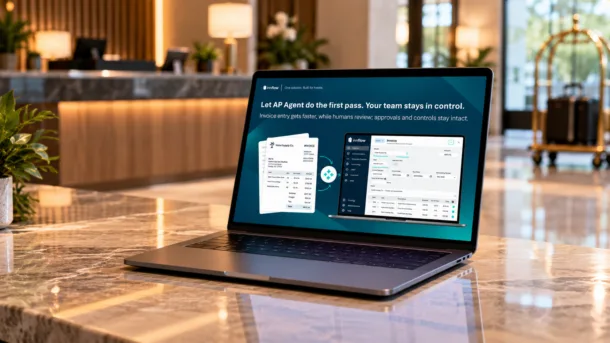
- Automate Accounts Payable. Manual AP processing is slow, error-prone, and difficult to scale. Automated AP workflows capture invoices, assign GL codes based on vendor and category, route for manager approval, and schedule payments without requiring staff to handle paper or re-enter data. Automation also creates a complete audit trail and prevents duplicate payments. Management companies that automate AP at scale reduce per-invoice processing cost and free controller time for higher-value analysis.
- Implement a Documented Close Checklist. The month-end close process includes dozens of steps that must be completed in a specific sequence. A documented checklist ensures that every step happens, every period, at every property, regardless of which staff member is executing it. The checklist should include reconciliation sign-offs, accrual reviews, depreciation postings, intercompany eliminations, and the final review before financial statements are distributed. Assign ownership for each step and track completion in real time.
- Integrate Labor and Accounting.
- Deliver Owner Reports on a Consistent Schedule. Ownership groups that receive financial reports on a reliable schedule make fewer ad hoc requests and have greater confidence in the management team. Establish a standard report package, define the delivery date after month-end close, and automate distribution where possible. The package should include the income statement, balance sheet, cash position, occupancy summary, and any variance commentary the management company provides. Consistency in format and timing is as important as content quality.
- Conduct Variance Review Before Close.
Implementing These Processes Across a Portfolio
Standardizing accounting processes across multiple properties requires both documentation and enforcement. Document each process in enough detail that a new property can adopt it without interpretation. Use software controls to enforce compliance where possible, such as requiring reconciliation sign-offs before the close can proceed, or restricting GL code access to prevent unauthorized account usage.
The management company’s accounting leadership should review process adherence across the portfolio regularly, not just when problems surface. Consistent processes, consistently applied, are what distinguish management companies that scale from those that add headcount proportionally with every new property.
How Inn-Flow Supports These Processes
Inn-Flow’s hotel accounting software is built around these workflows. Daily reconciliation tools, automated AP, a documented close workflow with task tracking, and direct integration with labor management and payroll are all part of a single platform designed for management companies.
See how the platform works at inn-flow.com/system-overview.
Frequently Asked Questions
What are the most important hotel accounting best practices for management companies?
Daily reconciliation, a standardized USALI chart of accounts, automated AP, and a documented close checklist are the foundation. Integrating labor and accounting data and delivering owner reports on a consistent schedule build on that foundation.
How does daily reconciliation improve hotel accounting accuracy?
Daily reconciliation compares PMS revenue to the general ledger and verifies cash deposits each day. Errors caught daily are easier to trace and correct than errors discovered at month-end after thirty days of additional transactions have accumulated.
Why should hotel management companies standardize their chart of accounts?
A standardized, USALI-aligned chart of accounts makes portfolio-level comparison possible. When every property uses the same account codes, management companies can analyze performance across properties without manually reconciling different account structures.
What is the benefit of automating hotel accounts payable?
AP automation reduces per-invoice processing cost, eliminates duplicate payments, creates a complete audit trail, and frees controller time for analysis rather than data entry. It also improves vendor relationships by processing payments on consistent schedules.
How does integrating labor and accounting improve hotel financial reporting?
When labor data flows automatically into the accounting system, department-level P&Ls reflect actual wage costs without manual data transfer. This eliminates reconciliation work and produces more accurate profitability analysis by department.