Most hotel operators trust their labor management platform to calculate overtime correctly. Why wouldn’t they? The software runs the payroll. The numbers come out. Employees get paid. Nobody flags anything. But trust without verification is a liability. FLSA hotel overtime compliance has specific, nuanced requirements—and many systems either weren’t built with hospitality’s operational complexity in mind, or haven’t kept up with how the industry actually works. The result is a discrepancy that’s silent in your payroll register and loud in a Department of Labor audit.
Here’s what your platform might be getting wrong—and why it matters more than you think.
| The most dangerous compliance gap isn’t the one you can see. It’s the one that’s been quietly miscalculating overtime for months. |
What FLSA Overtime Rules Do Most Hotel Labor Platforms Get Wrong?
1. Multi-Rate Overtime: The Blended Rate Requirement
Hospitality employees routinely wear multiple hats in a single workweek—a front desk associate who picks up shifts in banquet serving, a maintenance tech who covers housekeeping during a busy weekend, a supervisor who clocks hours at two properties. This is normal. What isn’t always normal is how the overtime is calculated.
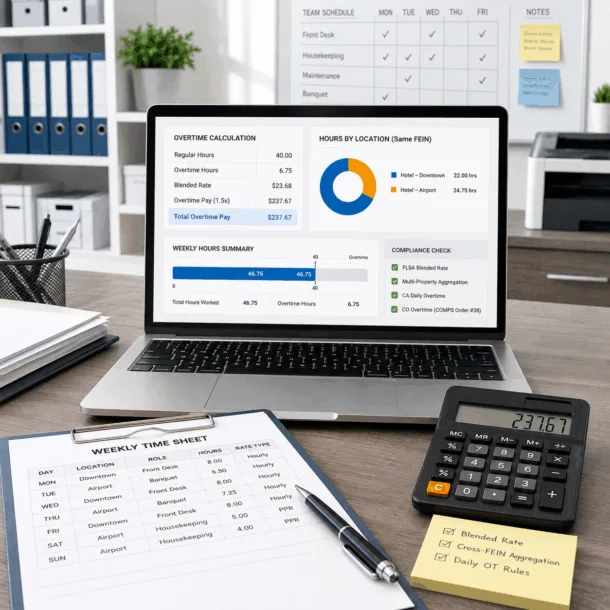
Under FLSA, when an employee works at more than one pay rate in a single workweek, overtime must be paid at 1.5× the blended regular rate—calculated as total straight-time earnings divided by total hours worked. It is not acceptable to simply apply 1.5× to whichever rate was active when the employee crossed the 40-hour threshold.
Many platforms default to the latter. It’s simpler to calculate, and it often results in paying the employee less than they’re owed. In a high-turnover, multi-role industry like hospitality, this isn’t an edge case—it’s happening every week.
2. Multi-Property (FEIN) Overtime: The Clock Doesn’t Reset at the Door
This one surprises even experienced operators. If an employee works across two or more hotels that operate under the same FEIN or payroll group, their hours must be combined when determining whether they’ve hit the 40-hour overtime threshold—and when calculating the blended rate.
An employee can’t have their overtime clock reset simply by clocking in at a sister property mid-week. Under FLSA, the workweek follows the FEIN, not the building. If Maria works 22 hours at your downtown property and 24 hours at your airport property—both under the same corporate entity—she’s owed overtime on 6 hours, at the blended rate across both jobs.
Systems that treat each property as a siloed payroll event will systematically underpay employees in this situation. Over the course of a year, the exposure compounds quickly.
3. State-Specific Overtime Rules: FLSA Is the Floor, Not the Ceiling
Federal law sets minimum standards. States can—and do—go further. For multi-state operators, this creates a compliance matrix that a platform has to actively manage.
California: Requires 1.5× overtime for hours over 8 in a workday (not just over 40 in a week), and 2× pay (double time) for hours over 12 in a workday or over 8 on the 7th consecutive day of work in a workweek. Daily overtime exposure is constant, regardless of weekly totals.
Colorado: Under COMPS Order #38, Colorado employees are owed 1.5× for hours over 12 in a workday, in addition to the standard weekly (>40 hours) and shift (>12 consecutive hours) triggers. Operators moving staff between shifts need a system that tracks daily totals, not just weekly accumulation.
A platform that only monitors weekly hours against a 40-hour threshold will miss every daily OT event in these states. For a full-service hotel running multiple shifts in California, that’s not a minor miss.
| Federal law sets the floor. California and Colorado are two stories up. Your platform needs to know which building it’s in. |
How Does Hotel Staffing Complexity Affect FLSA Overtime Calculations?
Pay Per Room: When Compensation Models Collide
Blended overtime gets meaningfully more complicated when housekeeping enters the picture. Many hotels compensate housekeepers on a pay-per-room (PPR) basis—a piece-rate model where earnings are tied to rooms cleaned, not hours worked. It’s common, it’s operationally practical, and under FLSA, it’s perfectly legal.
But the overtime math requires an extra step. When an employee earns under PPR, their “regular rate” for overtime purposes must be recalculated: total piece-rate earnings divided by total hours worked in the workweek. That calculated rate is then the base for the overtime premium—and it changes week to week based on productivity and hours.
Now layer in the scenarios described above:
- A housekeeper who earns PPR at one property but clocks hourly hours at another (both under the same FEIN)
- A housekeeper who works PPR shifts on some days and hourly shifts on others in the same workweek
- A housekeeper working in California whose daily hours trigger state OT rules on top of the PPR rate calculation
Each of these scenarios is a real staffing pattern that happens in full-service and extended-stay hotels every week. Each one requires a distinct calculation. The compounding is fast—and the margin for error is significant.
Why Do FLSA Compliance Gaps Go Undetected in Hotel Payroll Systems?
The reason these discrepancies persist isn’t malicious—it’s architectural. Most labor platforms were built to handle the common case: one employee, one pay rate, one property, weekly accumulation. They do that well.
What they weren’t always designed for is hospitality’s actual complexity: workers who move between roles and properties, compensation models that mix hourly and piece-rate pay, and state laws that require daily as well as weekly tracking.
The result is a system that looks like it’s working. Reports generate. Payroll closes. No exceptions are thrown. But beneath the surface, the calculations are off—quietly, consistently, and compliantly.
Until they’re not.
What Does FLSA-Compliant Labor Calculation Require for Multi-Property Hotels?
FLSA-compliant labor calculation in a multi-property hotel environment requires a system that can:
- Aggregate hours across all positions and properties within a FEIN before applying the 40-hour threshold
- Calculate the true blended regular rate across all earnings—hourly, salaried, and piece-rate—within a workweek
- Apply the correct 1.5× or 2× multiplier based on both federal and applicable state rules
- Handle pay-per-room as a recognized compensation type with proper rate recalculation for OT purposes
- Track daily hour totals separately for states like California and Colorado that require it
This isn’t a wish list. It’s the baseline for operating legally in a complex staffing environment. The question for any operator is whether their current labor management platform actually does all of it—or just looks like it does.
| Compliance isn’t a feature you add later. It’s the foundation the whole calculation sits on. |
What Is the Cost of FLSA Non-Compliance for Hotel Operators?
FLSA violations carry back pay liability going back two years—three if the violation is found to be willful. In a class action context, that’s compounded across every affected employee. Add liquidated damages (which courts often award at the same amount as the back pay), legal fees, and reputational exposure, and the financial picture shifts quickly.
More practically: in a labor market where hospitality operators are already competing hard for workers, underpaying employees—even unknowingly—erodes the trust that retention depends on.
The most important question you can ask your labor platform vendor isn’t “can you handle overtime?” It’s “how exactly do you handle it—and can you show me?”
The answer will tell you everything.
Frequently Asked Questions: FLSA Hotel Overtime Compliance
What is the blended regular rate under FLSA?
The blended regular rate is calculated by dividing an employee’s total straight-time earnings across all pay rates in a workweek by their total hours worked. This rate—not the rate at which the 40th hour was worked—is the basis for the 1.5× overtime premium when an employee works at multiple pay rates during the same workweek.
Do hotel employees who work at multiple properties earn overtime?
Yes. If two properties operate under the same FEIN, an employee’s hours across both locations must be combined to determine whether they’ve exceeded 40 hours and to calculate the blended rate for overtime purposes. The overtime clock does not reset when an employee clocks into a sister property.
How does California overtime law differ from federal FLSA rules for hotels?
California requires 1.5× overtime for hours over 8 in a single workday (not just over 40 in a week) and 2× pay for hours over 12 in a workday or over 8 on the 7th consecutive day of a workweek. Hotel operators with California properties must track daily hours, not just weekly accumulation. Federal FLSA is the floor; California’s rules go significantly further.
What is pay-per-room (PPR) overtime and how is it calculated under FLSA?
Under a piece-rate model like PPR, an employee’s regular rate for overtime is recalculated each workweek: total piece-rate earnings ÷ total hours worked. The overtime premium (0.5× the calculated regular rate) is then applied to all hours over 40—not a fixed hourly wage. This calculation changes week to week based on productivity and hours.
What are the penalties for FLSA overtime violations in hotel operations?
FLSA violations can result in back pay liability going back two years (three years for willful violations), liquidated damages equal to the back pay owed, legal fees, and potential class action exposure across all affected employees. The Department of Labor’s Wage and Hour Division actively investigates hospitality employers, making this a high-priority compliance area for hotel management companies.
How can I tell if my labor platform is calculating FLSA overtime correctly?
Ask your vendor to demonstrate exactly how the system handles: (1) multi-rate overtime calculations across a single workweek, (2) cross-property hour aggregation for employees sharing a FEIN, (3) pay-per-room earnings in blended rate calculations, and (4) daily overtime tracking for California and Colorado. Request a sample calculation—not a feature checklist.