The best hotel accounting software for management companies supports USALI-compliant chart of accounts, integrates with your property management system, handles multi-entity consolidation, and delivers department-level P&L without manual workarounds. Purpose-built platforms outperform generic ERPs and small-business tools for this use case.
Key Takeaways
- Management companies need USALI-native software, not generic accounting tools adapted for hotels
- PMS integration determines how much manual data entry your team absorbs daily
- Multi-entity consolidation is essential for portfolios of two or more properties
- Purpose-built platforms typically reduce month-end close time compared to spreadsheet-heavy workflows
- Total cost of ownership includes implementation, training, and ongoing support, not just licensing
What Makes Hotel Accounting Software the Best Choice
Selecting the right hotel accounting software is not just a technology decision. It shapes how quickly your team closes the books, how reliably department managers see their costs, and how confidently ownership groups receive financial reports. Management companies carry additional complexity because they operate multiple properties under one entity structure, often with different ownership groups, brand standards, and PMS environments. Software that excels for a single independent hotel may collapse under that load.
The criteria that separate the best platforms from adequate ones include: native USALI chart of accounts, PMS integration depth, multi-entity architecture, and automated financial reporting. The comparison below breaks down how the major categories of software stack up.
Software Comparison: Purpose-Built vs Generic ERP vs Small Business Tools
How the three main software categories compare on criteria that matter for hotel management companies: 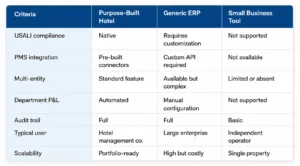
QuickBooks for Hotels: Where It Falls Short
QuickBooks is the dominant small-business accounting platform in North America, and many independent hotel operators start there. For a single property with straightforward finances, it can work. For management companies, it creates significant problems.
QuickBooks does not have a native USALI chart of accounts. Operators must build one manually, and maintaining it across multiple entities multiplies the effort. PMS integration is limited and often requires third-party middleware that adds cost and fragility. Multi-entity consolidation requires exporting data from multiple QuickBooks files and combining them in spreadsheets, which introduces errors and slows the close cycle.
These are not minor inconveniences. They represent systematic labor costs that compound as a portfolio grows. Teams that outgrow QuickBooks often find themselves spending significant controller hours each month on reconciliation that should be automated.
NetSuite for Hotels: Power With Complexity
Oracle NetSuite is a full enterprise resource planning platform with strong multi-entity and multi-currency support. For hotel management companies that also operate non-hotel businesses, it can provide a unified financial backbone. However, it is a general ERP, not a purpose-built hotel accounting system.
NetSuite requires significant customization to support USALI, and those customizations must be maintained through software updates. PMS integration is possible but typically requires custom development. The implementation timeline and licensing cost are substantially higher than purpose-built hotel platforms. Organizations with complex holding structures sometimes choose NetSuite for enterprise-wide consolidation while using a hotel-specific tool at the property level.
M3 for Hotels: Industry-Specific but Evaluate Fit
M3 is a purpose-built hotel accounting platform that has served the industry for decades. It understands USALI, department-level reporting, and the rhythms of hotel finance. It serves a meaningful segment of independent and managed hotels in North America.
Evaluating M3 requires assessing whether its PMS integrations include your specific systems, whether its reporting layer meets your ownership reporting requirements, and what its implementation and support model looks like for your portfolio size. Like any platform, it has strengths and gaps that vary by use case.
Purpose-Built Hotel Accounting Features Worth Evaluating
When evaluating any purpose-built platform, the business intelligence and reporting layer deserves particular attention. The ability to produce owner-ready reports, consolidated portfolio views, and department-level variance analysis without custom development separates platforms that fit management companies from those built for single-property use.
Key features to evaluate in purpose-built hotel accounting software:
- USALI-native chart of accounts that does not require manual customization
- PMS integration that eliminates daily manual revenue posting
- Multi-entity structure that supports portfolio consolidation
- Department-level P&L aligned with operational management
- Automated bank reconciliation and transaction matching
- Owner report templates that can be scheduled and distributed
- Role-based access that separates property-level from corporate-level permissions
For management companies that also handle bookkeeping services for property owners, the platform must also support clear separation of entities and streamlined workflows that allow a small accounting team to serve multiple properties without proportional headcount growth.
Evaluation Criteria for Management Companies
USALI Compliance
The Uniform System of Accounts for the Lodging Industry is the industry standard for hotel financial reporting. Any software that requires significant customization to support USALI creates ongoing maintenance burden. Verify that the chart of accounts structure, department designations, and reporting templates align with USALI without custom development.
PMS Integration
Your property management system is the source of truth for revenue, occupancy, and room statistics. The accounting platform must pull this data automatically and accurately. Ask vendors to demonstrate the specific integration with your PMS, not a generic API capability.
Multi-Entity Architecture
Management companies need to operate multiple entities within a single platform, with clear separation for ownership reporting and consolidated views for portfolio oversight. Confirm that the entity structure supports your ownership configurations.
Scalability
A platform that handles three properties well may not scale cleanly to thirty. Understand how pricing scales with property count and whether the architecture supports the portfolio size you are targeting.
Implementation and Support
Implementation timelines for hotel accounting software typically run four to twelve weeks depending on complexity. Assess the vendor’s implementation methodology, data migration support, and ongoing customer success resources.
Inn-Flow: Built for Hotel Management Companies
Inn-Flow is a purpose-built hotel financial management platform designed specifically for management companies. The platform includes native hotel accounting software, automated bookkeeping workflows, and integrated business intelligence that connects accounting data to operational metrics across your portfolio.
Inn-Flow supports USALI out of the box, integrates with major PMS platforms, and is built for multi-entity management company structures. The platform is designed to reduce manual work, accelerate the close cycle, and give ownership groups the financial visibility they need.
Learn more about Inn-Flow’s capabilities at inn-flow.com/system-overview or review pricing for management companies.
Frequently Asked Questions
What is the best hotel accounting software for a management company with 10+ properties?
Purpose-built platforms that support multi-entity consolidation, USALI compliance, and PMS integration are the best fit. Generic small-business tools and standard ERPs require significant customization that creates ongoing maintenance costs.
Can QuickBooks handle hotel accounting for a management company?
QuickBooks can work for a single independent property with simple finances. For management companies managing multiple properties, the lack of native USALI support, limited PMS integration, and manual multi-entity consolidation create meaningful operational and accuracy problems.
How long does it take to implement hotel accounting software?
Implementation timelines typically range from four to twelve weeks depending on portfolio size, data migration complexity, and the number of PMS integrations required. Purpose-built hotel platforms generally implement faster than general ERPs because they require less customization.
What is USALI and why does it matter for hotel accounting software?
USALI stands for Uniform System of Accounts for the Lodging Industry. It is the standard chart of accounts and financial reporting framework for hotels. Software with native USALI support allows management companies to produce standardized financial reports that ownership groups and lenders expect without building the structure manually.
Does hotel accounting software integrate with PMS platforms?
Purpose-built hotel accounting platforms typically offer pre-built integrations with major PMS systems. Generic accounting software requires custom API development for PMS integration, which adds cost and creates ongoing maintenance requirements.