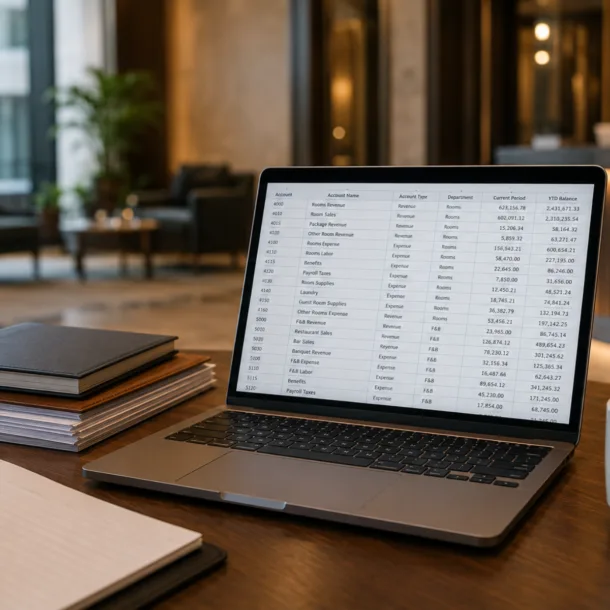
A hotel chart of accounts is the organized list of general ledger accounts that categorizes every financial transaction a hotel records. Unlike a generic business chart of accounts, it is structured around USALI department codes — Rooms, Food and Beverage, Spa, Parking, and other operating departments — so operators can see a P&L for each department, not just the property as a whole. Hotel accounting software built for hospitality implements this structure natively; generic software requires manual configuration that is difficult to maintain consistently.
Key Takeaways
- A hotel chart of accounts is organized by USALI department codes, enabling department-level P&L reporting that generic business charts of accounts cannot produce without significant customization.
- The structure matters as much as the content — consistent account numbering across properties enables cross-property benchmarking and portfolio consolidation.
- Common chart of accounts mistakes — inconsistent numbering, wrong USALI mapping, misclassifying fixed vs. variable costs — distort departmental P&L and undermine operational decision-making.
- Full-service hotels typically require 300 to 600 accounts; limited-service properties can operate with fewer, but both require the USALI department framework.
- The chart of accounts is the foundation of financial reporting — errors here propagate through every report the property produces.
What Is USALI and Why Does It Drive Hotel Chart of Accounts Design
USALI stands for Uniform System of Accounts for the Lodging Industry. It is the standard accounting framework developed for the hospitality industry and maintained by the Hotel Association of New York City. Currently in its 11th edition, USALI defines how hotels should organize their financial data — which departments to track separately, how to classify revenue and expense accounts, and how to present the income statement.
The USALI framework exists because hotel operations are fundamentally different from other businesses. A hotel does not produce a single product — it produces rooms, meals, meeting space, spa services, parking, and more simultaneously. Without a standardized way to track each of these departments, comparing performance across properties or against industry benchmarks is impossible.
The hotel chart of accounts reflects USALI by organizing GL accounts into department-level groupings. Revenue accounts for Rooms sit in the Rooms department. Labor and direct costs for Food and Beverage sit in the F&B department. Overhead accounts that cannot be attributed to a single department sit in undistributed operating expenses.
Standard Department Structure in a Hotel Chart of Accounts
Revenue Departments
Revenue departments generate direct income. Each has its own revenue, labor, and direct expense accounts in the chart of accounts. Standard revenue departments include:
- Rooms — accommodation revenue, room attendant labor, guest supplies, laundry
- Food and Beverage — restaurant and bar revenue, kitchen labor, food and beverage cost
- Spa — treatment revenue, retail sales, therapist labor, product cost
- Parking — parking revenue, valet labor, equipment maintenance
- Other Operated Departments — includes any additional revenue centers not covered above
Undistributed Operating Expenses
Undistributed expenses are costs that support the whole hotel but cannot be attributed to a single revenue department. USALI organizes these into specific categories:
- Administrative and General — accounting, legal, HR, office supplies
- Information Technology — software, hardware, support
- Sales and Marketing — advertising, PR, sales labor, commissions
- Property Operations and Maintenance — engineering labor, repairs, utilities
- Utilities — electric, gas, water (sometimes within Property Operations)
Non-Operating Items
Below the departmental operating income line, USALI captures management fees, rent, property taxes, insurance, depreciation, and interest expense. These items affect net operating income and net income but are separated from operating performance to allow fair comparison across properties with different ownership structures.
GL Account Numbering in Hotel Accounting
Account numbering in a hotel chart of accounts follows a structure that encodes the department, account type, and sub-account. Bookkeeping accuracy depends on consistent application of this structure — every transaction coded to the wrong account distorts departmental P&L and requires correction.
A typical numbering scheme uses a prefix for the department code, followed by a suffix for the account type. For example, Rooms department accounts might begin with 40, F&B with 50, and Administrative and General with 80. Revenue accounts within a department might end in 00-09, labor in 10-29, and direct expenses in 30-99.
The specific numbers matter less than consistency. When account 4010 means Rooms Labor at every property in a portfolio, the controller can run a cross-property labor report without any manual translation. When each property uses different numbering, cross-property analysis requires a mapping table that must be maintained manually.
Common Chart of Accounts Mistakes in Hotel Accounting
Inconsistent Department Mapping
When properties in a portfolio use different department structures — one property has a separate Laundry department, another includes laundry within Rooms — cross-property comparison is impossible without manual adjustment. Standardizing the department structure during onboarding is far easier than retroactively restructuring an established chart of accounts.
Misclassifying Variable vs. Fixed Costs
Labor benefits, workers’ compensation, and payroll taxes are sometimes posted to a single payroll account rather than allocated to the department that incurred them. This inflates undistributed expenses and understates departmental labor cost, distorting the departmental P&L.
Using the Wrong Revenue Account
Complimentary rooms, employee meals, and negotiated rate variances sometimes get posted to revenue accounts that do not reflect their true nature. Complimentary rooms should be tracked separately from accommodation revenue. Gift card redemptions require specific handling to avoid overstating or understating revenue.
Insufficient Sub-Account Granularity
A chart of accounts that is too high-level cannot support detailed operational analysis. If all food cost posts to a single F&B cost account rather than separate accounts for food cost and beverage cost, operators cannot track food cost percentage independently from beverage. The chart of accounts should match the level of detail needed for management decisions.
Cross-Property Consistency and Why It Matters
For hotel management companies, the chart of accounts is not a property-level decision — it is a portfolio-level policy. Business intelligence tools that produce cross-property reports and owner dashboards depend entirely on consistent underlying account structures. When one property uses account 4010 for Rooms Labor and another uses 4050, any report spanning both properties is inaccurate without a manual mapping step.
The practical implication is that management companies should establish and enforce a standard chart of accounts before onboarding new properties. Every property should use the same account numbering, the same department structure, and the same classification conventions. Exceptions should require explicit controller approval and documentation.
When acquiring or transitioning a property from a previous operator, mapping the existing chart of accounts to the standard before the first close is essential. Trying to clean up a non-standard chart of accounts after six months of transactions is significantly more difficult than converting it at the start.
How Inn-Flow Addresses This
Inn-Flow includes a USALI-compliant hotel chart of accounts that is pre-configured and ready to implement across properties. Hotel accounting software from Inn-Flow enforces consistent account structures across entities, eliminating the cross-property mapping work that generic platforms require. The accounting module connects directly to the business intelligence layer, so department-level data from the chart of accounts flows into owner dashboards and portfolio reports without manual translation.
Frequently Asked Questions
What is a hotel chart of accounts?
A hotel chart of accounts is the organized list of GL accounts used to categorize all financial transactions in a hotel. It is structured around USALI department codes, which divide accounts by operating department, enabling department-level P&L reporting.
What is USALI and how does it relate to the hotel chart of accounts?
USALI stands for Uniform System of Accounts for the Lodging Industry. It is the industry-standard accounting framework that defines department codes, account classifications, and P&L format for hotels. The hotel chart of accounts is built around USALI department and sub-account structures.
Why does account numbering matter in a hotel chart of accounts?
Consistent account numbering enables cross-property reporting and benchmarking. When account 4000 means the same thing at every property in a portfolio, financial data can be compared and consolidated without manual translation. Inconsistent numbering makes cross-property analysis a manual, error-prone process.
How many accounts does a typical hotel chart of accounts have?
A full-service hotel chart of accounts typically includes 300 to 600 accounts, depending on the property’s complexity and number of operating departments. Limited-service hotels may operate with 150 to 300 accounts. The exact count depends on the level of departmental granularity required.
Can I customize a hotel chart of accounts?
Yes, but customization should be done carefully. The USALI framework is a guideline, not a regulation. Adding sub-accounts for more granular tracking is fine, but changing the department structure or account numbering convention in ways that deviate from USALI will limit your ability to compare performance against industry benchmarks.