Hotel management companies face accounting challenges that single-property operators and non-hospitality businesses never encounter: managing dozens of separate legal entities, producing customized owner reporting for multiple ownership groups, maintaining USALI compliance across inconsistent legacy systems, and scaling financial operations without hiring proportionally. These are structural challenges that require hotel accounting software designed for portfolio operators, not generic tools configured to approximate the right structure.
Key Takeaways
- Hotel management companies manage accounting for multiple legal entities simultaneously, each with its own books and owner reporting requirements.
- USALI compliance is difficult to maintain consistently across properties with different histories and systems.
- Labor cost is the largest expense line and the hardest to allocate accurately without integrated scheduling and time-tracking data.
- Owner reporting demands vary by ownership group and management agreement, creating a customization challenge at scale.
- Disconnected systems — PMS, payroll, AP, and accounting — create manual bridging work that compounds as the portfolio grows.
Challenge 1: Multi-Entity Legal Structure
Most hotels operate as separate legal entities. A management company with 25 properties typically manages 25 or more LLCs, each requiring its own chart of accounts, general ledger, balance sheet, and financial statements. The management company itself has its own entity for fee income.
Keeping these entities organized, reconciled, and accurately reported is a significant operational challenge. When any entity falls behind on reconciliation, it delays the portfolio-level close. When entities use inconsistent account structures, cross-property reporting is impossible without manual translation.
The practical impact is that entity management consumes significant controller time — time that would be better spent on financial analysis and owner relationships rather than structural housekeeping.
Challenge 2: Owner Reporting at Scale
Every ownership group expects a monthly financial package reflecting their specific properties, formatted according to their preferences and the terms of their management agreement. Business intelligence tools built for hotel portfolios can generate these packages automatically from standardized data — but only when the underlying accounting data is clean and consistently structured.
Management companies with 10 or more ownership groups produce 10 or more distinct monthly reporting packages. If each package takes two to four hours to assemble manually, owner reporting alone represents a significant portion of the accounting team’s month-end workload.
The challenge compounds when owners have non-standard requirements: weekly cash flash reports, specific KPI definitions, or lender-mandated formats that differ from the standard management reporting package.
Challenge 3: USALI Compliance Across Properties
USALI provides a standardized chart of accounts and reporting framework for the lodging industry. When implemented consistently, it allows operators to compare department-level performance across properties and benchmark against industry data.
The challenge for management companies is consistency. Properties acquired from different operators, managed under different legacy systems, or onboarded at different times often arrive with incompatible account structures. Retroactively standardizing these structures requires significant rework.
Without consistent USALI implementation, cross-property P&L comparison is manual. Department-level expense analysis requires reconciling different account codes. Budget-versus-actual reporting requires custom mapping for each property. All of this work falls on the accounting team.
Challenge 4: Daily Income Audit Accuracy
The daily income audit is the foundation of hotel accounting. Revenue posted from the PMS each night must reconcile with the front desk closing report, credit card settlements, and advance deposit movements. When this reconciliation is accurate daily, month-end close is manageable. When it is not, errors accumulate.
The challenge is that daily income audits are often manual — someone exports data from the PMS, formats it, and compares it to GL entries. This process takes time and introduces human error. Discrepancies small enough to ignore on any given day become significant by month-end.
Management companies operating many properties simultaneously cannot afford to have every income audit require individual manual attention. Automation of the PMS-to-GL posting process is not an optimization — it is a prerequisite for scale.
Challenge 5: Labor Cost Allocation
Labor is the largest expense category in hotel operations. Labor management tools that integrate scheduling, time-and-attendance, and payroll data with the accounting system allow operators to see labor cost by department in real time, not just after payroll processes.
The challenge is that labor cost allocation requires accurate department-level time tracking. When employees work across departments — a housekeeper also working in laundry, for example — the hours must be allocated to the correct cost centers. Without integrated systems, this allocation is an estimate based on schedules rather than actual time.
Inaccurate labor allocation distorts departmental P&L. Rooms may appear more or less profitable than it actually is. F&B costs may be understated. The income statement reflects approximations rather than actuals, which limits its usefulness for operational decision-making.
Challenge 6: Scaling Without Adding Headcount
The business model of hotel management companies depends on operating leverage. Revenue grows as the portfolio grows, but operating costs — including accounting headcount — should not grow proportionally. Controllers who manage 10 properties should be able to manage 20 with better systems, not twice the staff.
The challenge is that most manual accounting workflows do not scale. Each additional property adds entity management overhead, owner reporting volume, and close complexity. Without systems automation, adding properties means adding accountants.
Management companies that build scalable accounting infrastructure early can absorb portfolio growth without proportional headcount increases. Those that grow first and systematize later find themselves retrofitting processes under operational pressure.
Challenge 7: Disconnected Systems
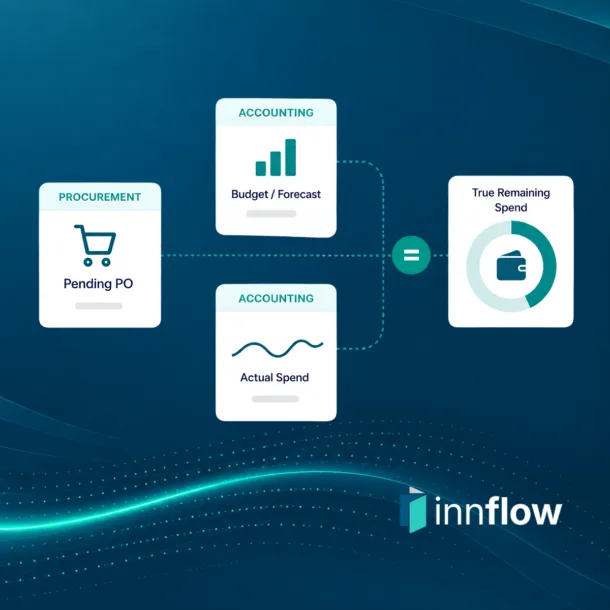
The typical hotel technology stack includes a property management system, a separate payroll and HR system, an accounts payable tool, and an accounting platform — often from different vendors with no native integration. Data moves between these systems manually, creating duplicate entry, reconciliation burden, and error exposure.
The integration challenge is not unique to hotels, but hospitality has more critical integration points than most industries. The PMS-to-accounting connection is non-negotiable. The payroll-to-accounting connection drives the largest expense line. The procurement-to-AP connection controls purchasing accuracy.
When these systems do not communicate, the accounting team becomes the integration layer — manually bridging data gaps that software should handle automatically.
How Inn-Flow Addresses This
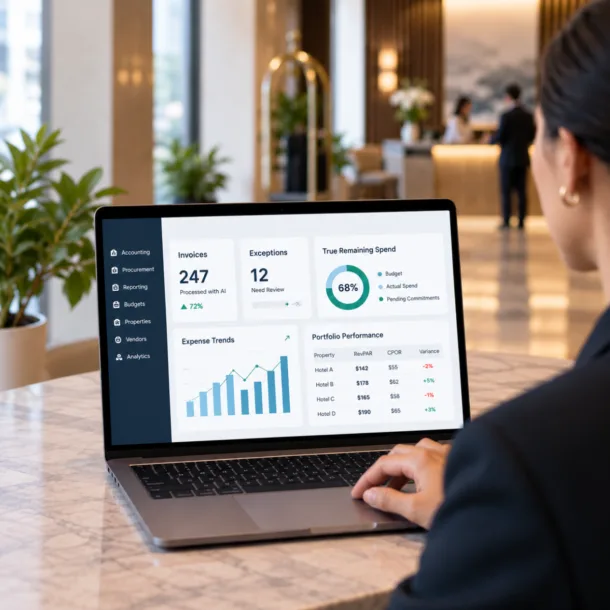
Inn-Flow addresses hotel accounting challenges for management companies by integrating the systems that typically operate in silos. Hotel accounting software, labor management, payroll, AP automation, and business intelligence tools work from a shared data foundation. Controllers get accurate department-level P&L, automated daily revenue posting, and owner reporting packages that assemble from verified data rather than manual assembly. The result is a management company that can grow its portfolio without growing its accounting department proportionally.
Frequently Asked Questions
What are the biggest hotel accounting challenges for management companies?
The biggest challenges are multi-entity legal structure management, owner reporting at scale, USALI compliance across properties, daily income audit accuracy, labor cost allocation, scaling without proportional headcount growth, and integrating disconnected financial systems.
Why is USALI compliance difficult for hotel management companies?
USALI compliance requires consistent chart of accounts implementation across every property. When properties were onboarded at different times or from different previous operators, the account structures often differ, making cross-property reporting inaccurate and consolidation manual.
How do hotel management companies handle owner reporting for multiple ownership groups?
Each ownership group typically requires a customized reporting package reflecting their specific properties, KPI preferences, and management agreement terms. Management companies without a scalable reporting workflow produce these packages manually each month, which is time-intensive and error-prone.
Why is labor cost allocation a challenge in hotel accounting?
Hotels with shared staff across departments or properties must allocate labor costs to the correct cost centers. Without integrated scheduling and time-tracking, this allocation is estimated rather than precise, creating inaccurate department-level P&L.
Can hotel management companies scale their accounting without adding staff?
Yes, with the right systems. Hotel accounting platforms that automate daily posting, AP workflows, and reporting production allow controllers to manage larger portfolios without proportional headcount increases. The critical investment is in integrated systems, not just additional accountants.