Key Takeaways
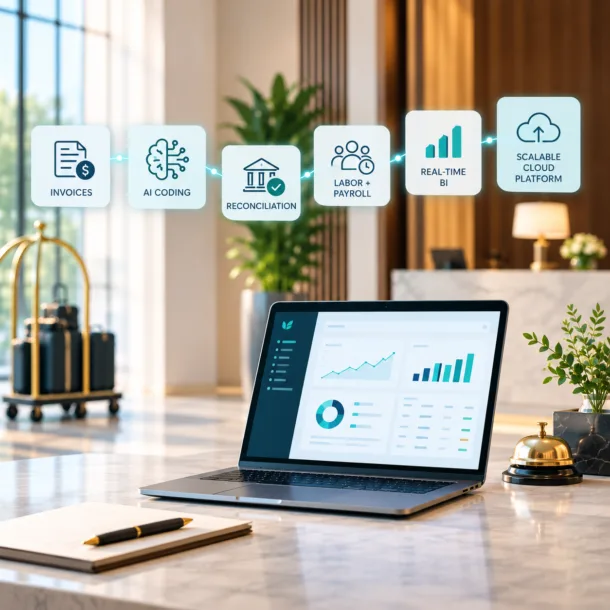
- AI-powered invoice coding is reducing AP processing time significantly for management companies with high invoice volumes.
- Automated daily reconciliation is replacing the traditional month-end scramble in forward-thinking hotel operations.
- Real-time BI dashboards have become an expectation rather than a differentiator in multi-property hotel management.
- The integrated labor-accounting-payroll workflow is the single highest-value automation chain in hotel finance.
- Cloud-native platforms are enabling management companies to scale operations without proportional increases in accounting headcount.
Hotel back-office operations have historically lagged other industries in automation. High employee turnover, complex compliance requirements, and a reluctance to change established processes have slowed adoption. That is changing quickly. Hotel accounting software providers are building automation capabilities that were not commercially viable even five years ago. This article describes the six trends that are reshaping hospitality finance and what they mean for controllers and CFOs.
6 Automation Trends Shaping Hotel Finance
Trend 1: AI-Powered Invoice Coding
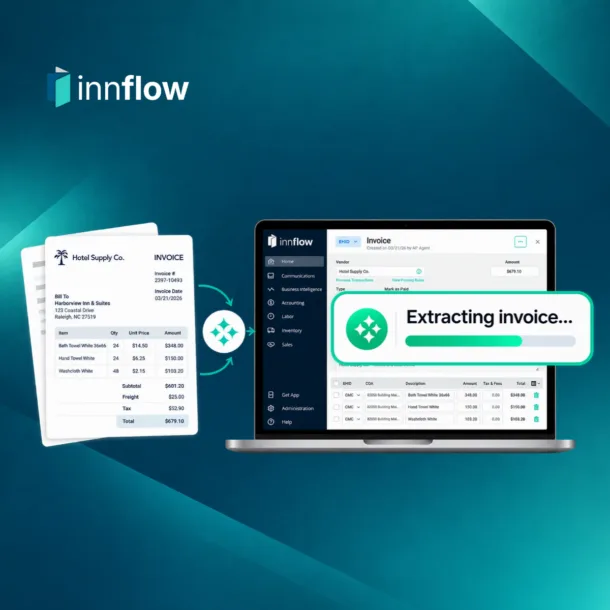
Accounts payable processing in hotels involves large volumes of invoices that must be reviewed, coded to the correct GL account and department, approved, and paid. Traditionally, each of those steps involved a human. AI-powered tools are now automating the coding step by analyzing invoice content and suggesting — or in some cases auto-applying — the correct GL account and department code based on vendor history and invoice characteristics.
The business case for AI invoice coding in hotels is strong because:
- Hotels receive invoices from dozens or hundreds of vendors every month
- Most recurring invoices from established vendors are highly predictable in their coding
- Coding errors are common and create reconciliation work downstream
- Controllers and bookkeepers spend significant time on a task that does not require their judgment on routine invoices
AI coding does not eliminate the need for human review, particularly for unusual invoices or new vendors. But it shifts the controller’s role from data entry to exception management — which is a better use of their expertise.
Trend 2: Automated Daily Reconciliation
Bank reconciliation in hotel accounting has traditionally been a month-end activity. Transactions accumulate throughout the month, and a controller works through them at close. This approach means that errors and unmatched transactions can sit undetected for weeks.
Automation is enabling daily reconciliation by matching bank transactions to GL entries in real time. Transactions that match automatically move through without human intervention. Transactions that do not match are flagged for review. The result is that month-end reconciliation becomes a confirmation exercise rather than a catch-up exercise.
Daily reconciliation also improves cash visibility throughout the month, which is particularly important for management companies that need to monitor cash positions across multiple properties for working capital and owner distribution purposes.
Trend 3: Real-Time Business Intelligence Dashboards
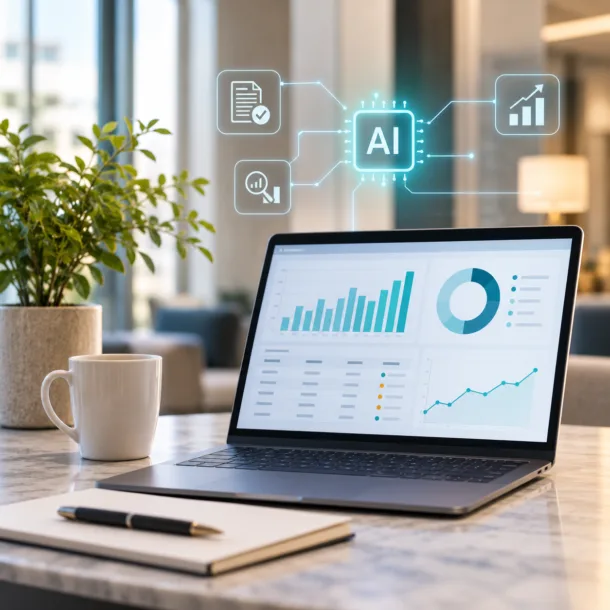
The expectation that financial performance data should be available on-demand — rather than delivered in a monthly report — has become the standard in progressive hotel management companies. Business intelligence platform tools that connect directly to accounting and labor data are enabling management teams to monitor KPIs, budget vs. actual variance, and labor cost percentage in real time rather than waiting for period-end compilation.
What has changed is not the concept of a dashboard but the connectivity and freshness of the data behind it. Early hotel dashboards often required manual data exports and updates. Current platforms update continuously as transactions post and schedules are completed.
This shift is changing the role of the monthly close. It is no longer primarily an information-delivery event — owners and operators already know how the month went from their dashboards. The close becomes primarily a control and documentation exercise, confirming that what was observed in real time is accurately recorded.
Trend 4: Integrated Labor-Accounting-Payroll Workflows
The most operationally significant automation trend in hotel finance is the integration of labor management, payroll, and accounting into a single connected workflow. In the traditional model, these three functions operate in separate systems with manual data transfers between them: time and attendance exports to payroll, payroll registers to accounting for manual journal entries. Labor management systems that are natively connected to payroll and accounting eliminate all of those manual transfers.
The integrated workflow operates as follows:
- Employees clock in and out using the labor management system
- Actual hours, department codes, and tip data flow automatically to payroll at period end
- Payroll processes and generates journal entries automatically mapped to GL accounts
- Journal entries post to the accounting system without manual intervention
- Department P&Ls update immediately with accurate labor costs
This workflow compresses what was previously a multi-day, multi-step process involving multiple staff members into an automated sequence. Controllers spend less time on data transfer and reconciliation and more time on analysis and management support.
Trend 5: Predictive Budgeting and Forecasting
Traditional hotel budgeting is a backward-looking process — historical data is used to project future performance. Predictive budgeting tools incorporate additional data sources: booking pace from the PMS, market demand signals, and machine-learning models trained on historical performance patterns.
The practical result is budget and forecast models that update continuously as new data arrives rather than being revised manually on a monthly or quarterly cycle. When occupancy pace changes, the labor forecast updates automatically. When revenue projections change, the full-year profitability model updates in real time.
This trend is still emerging in hospitality. The management companies adopting it earliest are typically larger operators with the data volume needed to train useful predictive models. But the underlying technology is becoming accessible at smaller scales as platform providers build it into their products.
Trend 6: Cloud-Native Finance Platforms
Hotel management companies that operate on legacy accounting systems — often desktop-installed software maintained separately at each property — face a compounding scalability problem. Adding properties requires adding licenses, maintaining additional installations, and managing increasingly complex data consolidation processes.
Cloud-native platforms eliminate the per-installation model entirely. New properties are onboarded to the same platform instance. Data is consolidated automatically in a shared environment. Users access the platform from any device without VPN or local installation requirements.
The scalability implication for management companies is significant. A company that grows from 10 to 50 properties on a cloud-native platform does not need to multiply its accounting infrastructure by five. The platform scales with the portfolio without proportional increases in technology overhead.
What This Means for Controllers and CFOs
The cumulative effect of these six trends is a fundamental shift in what hotel finance professionals spend their time on. Tasks that were previously done manually — invoice coding, reconciliation, payroll journal entries, data compilation for dashboards — are increasingly automated. The role of the controller is shifting toward exception management, financial analysis, and strategic support for operations.
This is a positive development for the profession. The most valuable work a controller can do is not matching invoices or preparing journal entries. It is analyzing performance, identifying risks, and providing the financial insight that drives better operational decisions. Automation creates the capacity for that work to happen.
For CFOs and VPs of Finance at management companies, the strategic question is not whether to automate but which investments will generate the most operational and financial return given their specific portfolio size and complexity.
The hotel finance teams that will thrive over the next decade are those that use automation to handle the transactional and move their expertise into the analytical.
How Inn-Flow Delivers Hospitality Finance Automation
Inn-Flow is built as a cloud-native, integrated platform for hotel management companies. hotel accounting software, labor management, payroll, and business intelligence are all connected on a single data model, enabling the automation trends described in this article without the integration complexity of connecting multiple standalone systems.
From AI-powered tools for invoice processing to real-time dashboard reporting and automated payroll-to-GL posting, Inn-Flow is designed to reduce the manual overhead in hotel back-office operations while improving the accuracy and timeliness of financial data.
Contact Inn-Flow to learn how the platform’s automation capabilities can benefit your hotel management company.
Frequently Asked Questions
What hotel finance tasks are most ready for automation?
Accounts payable invoice coding, bank reconciliation, payroll journal entry posting, and financial report compilation are the tasks most ready for automation today. They are high-volume, rule-based, and time-consuming — which makes them ideal candidates for the current generation of automation tools.
Does hospitality finance automation reduce accounting headcount?
Automation typically does not eliminate accounting roles in hotel management companies but redistributes the work within those roles. Controllers who previously spent significant time on data entry and manual reconciliation can shift that time toward analysis, variance investigation, and strategic financial support. Growing companies often find that automation allows them to scale their portfolio without adding accounting headcount proportionally.
What is the risk of AI-powered invoice coding in hotel accounting?
The primary risk is incorrect coding that passes through without human review. AI coding tools are most reliable for recurring invoices from established vendors with consistent transaction patterns. Novel invoices, new vendors, and unusual expense categories should always route to human review. Most platforms allow organizations to configure confidence thresholds that determine when auto-coding applies versus when human review is required.
How does real-time financial data change the monthly close process?
When financial data updates continuously throughout the month, the close process shifts from information delivery to control verification. The close no longer exists primarily to tell stakeholders how the month went — that is already known from dashboards. It exists to confirm that all transactions have been captured accurately, reconcile any remaining items, and produce the formal documentation that audits and owner reporting require.
Are cloud-native hotel finance platforms secure enough for sensitive financial data?
Leading cloud-native platforms invest heavily in security infrastructure — encryption in transit and at rest, role-based access controls, audit logging, and regular security audits. For most hotel management companies, cloud platforms provide stronger security posture than self-maintained on-premise or desktop installations that may not receive timely security updates.