Key Takeaways
- Accounting teams cannot close accurately without timely, accurate operational data from property teams.
- Operations teams cannot make good decisions without timely financial feedback from accounting.
- Siloed functions create reporting delays, budget disconnects, and reactive rather than proactive management.
- Shared financial data platforms are the technical foundation for cross-functional collaboration.
- The GM’s financial accountability is a central lever for improving property-level performance.
Why They’re Often Siloed
In most hotel management companies, accounting and operations evolved as separate functions with separate reporting lines, separate tools, and separate definitions of success. Operations teams are measured on guest satisfaction, occupancy, and RevPAR. Finance teams are measured on close accuracy and reporting timeliness. These goals rarely feel like they are in conflict — until month-end, when operations staff are asked to code invoices, reconcile petty cash, or explain budget variances they were never made aware of in real time. A shared hotel accounting platform gives both teams the foundation to collaborate rather than operate in parallel.
The structural cause of siloing is that the tools these teams use were never designed for cross-functional transparency. The PMS shows operational data to the GM but does not surface financial context. The accounting system shows financial data to the controller but relies on manual inputs from operations to close correctly.
What Accounting Needs From Operations
The accounting close process depends on inputs from the property operations team. Without these inputs, the close is either delayed or inaccurate:
- Daily revenue reconciliation: the front desk and night audit have to confirm that PMS revenue matches what was posted, and flag any discrepancies before accounting can close the revenue cycle.
- Invoice coding and approval: department managers need to code and approve invoices for their areas promptly. Delays in this process are one of the most common causes of extended close cycles.
- Inventory and requisition data: for F&B and housekeeping, physical counts and usage data affect cost of goods calculations and must be provided by operations staff.
- Labor hours confirmation: payroll accuracy depends on managers confirming and approving hours, including overtime and tip allocations.
- Expense and petty cash documentation: cash advances and small purchases need receipts and coding to close correctly.
When operations staff treat these tasks as a lower priority than guest-facing responsibilities, the accounting team’s close cycle suffers. The solution is not to make accounting louder — it is to give operations staff the tools and context that make their accounting contributions efficient and clear.
What Operations Needs From Accounting
Operations leaders — especially GMs and department heads — need financial data to manage their properties effectively. What they typically need and rarely get in a timely way:
- Labor cost actuals versus budget, by department and pay period — not just at month-end.
- Variance analysis that explains where the property is running above or below budget, with enough detail to identify the driver.
- Revenue performance data that reconciles to the financial statements rather than just the PMS.
- Comparative data against prior periods and similar properties in the portfolio.
When GMs have access to hotel labor management data that integrates directly with accounting, they can see whether their scheduling decisions are tracking within budget before the month ends — and adjust rather than explain after the fact.
Operations leaders who receive financial information only at month-end are effectively flying blind for most of the month. They cannot course-correct labor costs, control discretionary spending, or make informed trade-offs between service investment and budget performance without real-time financial context.
How Shared Financial Data Closes the Gap
The most effective way to reduce friction between accounting and operations is to give both teams access to a shared financial data layer. When department managers can see their budget position in real time, they do not need to wait for the accounting team to produce a report. When the accounting team has automated feeds from the PMS and labor system, they do not need to chase operations staff for data. Shared business intelligence dashboards that pull from the same source as the accounting general ledger eliminate the version conflicts that drive friction.
Shared financial data also creates accountability alignment. When both teams see the same numbers in real time, the GM can no longer treat budget variances as an accounting issue, and the controller can no longer treat labor overruns as an operations problem. Shared visibility creates shared ownership.
The GM’s Role in Financial Accountability
The most important single point of integration between accounting and operations is the general manager. GMs who understand their property’s financial position — and who are held accountable for it — drive better outcomes than those who treat finance as a back-office function.
Financial accountability for GMs requires:
- Access to real-time financial data in a format they can actually use — not just an accountant’s P&L.
- Clear targets: labor cost ratios, department-specific cost controls, and revenue floors.
- Regular financial reviews with enough context to understand variances and act on them.
- A direct line to the accounting team for questions about figures they do not understand.
Management companies that invest in financial literacy for GMs — and give them the tools to act on financial data — consistently see better property-level financial performance than those that treat finance as a separate function.
Financial Review Cadence
A structured financial review cadence is the operational mechanism for sustained accounting-operations collaboration. The cadence typically looks like this:
Daily
Night audit reconciliation. Revenue variance review. Labor cost check against forecast. Exception flags from the accounting system reviewed by the GM or department head.
Weekly
Labor actuals versus budget by department. Accounts payable aging review. Open purchase orders and pending invoices. Revenue pacing versus forecast.
Monthly
Full P&L review with the GM and department heads. Budget variance discussion by department. Prior month close confirmation. Owner report review before distribution.
The monthly review is where the gap between accounting and operations is most visible. Companies that run structured monthly reviews with both teams present — rather than sending the P&L by email and hoping for questions — have materially better budget adherence and fewer surprises in owner reports.
Inn-Flow Connects Accounting and Operations
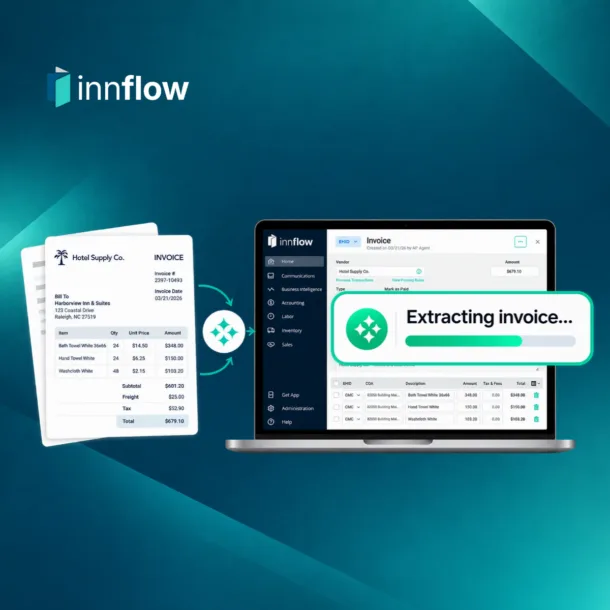
Inn-Flow gives accounting and operations teams a shared financial data layer — so controllers close faster and GMs manage with current information. Labor, accounting, and BI operate on the same platform, eliminating the version conflicts and data lag that keep these teams siloed. See how Inn-Flow supports cross-functional hotel management or contact us to discuss your current collaboration challenges.
Frequently Asked Questions
Why do hotel accounting and operations teams often conflict?
The conflict usually comes from information asymmetry. Operations teams make decisions without financial context, and accounting teams close books without full operational data. Shared systems and a structured review cadence resolve most of this friction.
What financial data should hotel GMs have access to?
GMs should see labor cost actuals versus budget by department, revenue performance against forecast, department-level expense tracking, and comparative data against prior periods. This should be available in real time, not just at month-end.
How does shared financial data improve accounting accuracy?
When accounting data is visible to operations in real time, department managers catch and correct errors faster. Invoice approvals happen more quickly, and reconciliation exceptions are flagged before they compound into month-end problems.
What is the most important change a management company can make to improve accounting-operations collaboration?
Giving both teams access to the same financial data platform, and establishing a structured monthly review with both functions present. Technology creates the capability; the review cadence creates the accountability.
How often should GMs review financial data?
Effective GMs review labor cost data daily or at least weekly, and conduct a full budget review with their accounting partner monthly. The daily and weekly reviews are where course corrections happen. The monthly review is where patterns are identified and decisions are made.