Hotel accounting and labor systems must share data to produce accurate department-level P&Ls, allocate wages correctly by department, and automate payroll journal entries. Without integration, labor costs flow into accounting manually, creating delays, errors, and department-level misallocations that distort the income statement.
Key Takeaways
- Labor data that stays in a scheduling system never contributes to financial reporting without manual transfer
- Integration enables automatic wage allocation to the correct department and GL account
- Payroll journal entries can be automated when labor data flows directly into accounting
- Department-level P&Ls are only as accurate as the underlying labor cost allocation
- Without integration, close cycles are longer and financial statements contain more estimated accruals
- Integrated systems produce the data needed for real-time labor cost visibility in financial reports
Why Hotel Accounting and Labor Systems Must Connect
Hotel accounting software and hotel labor management platforms address different operational problems, but they both ultimately serve the same financial question: what did it cost to operate this property, and how does that cost break down by department? The answer requires both systems to share data. When they do not, the financial reporting reflects what the accounting system was told, not what actually happened in operations.
The labor-accounting integration is not just a convenience. It is what makes department-level P&L analysis possible, what enables accurate payroll journal entries, and what allows management companies to produce financial reports that ownership groups can rely on.
What Data Flows From Labor to Accounting
The primary data that must flow from labor systems to accounting includes:
- Hours worked by employee, shift, and department for each pay period
- Regular, overtime, and holiday hours separated by pay rate classification
- Department assignment for each hour worked, including split-department assignments
- Wage rate information used to calculate total wage cost by department
- Tip data where applicable for payroll compliance and P&L reporting
- Benefit cost allocation by department where benefits are department-tracked
When this data flows automatically, the accounting system can allocate labor cost to the correct department P&L without manual input. When it does not flow automatically, someone on the accounting team must transfer it, introducing both delay and the risk of error.
Department Wage Allocation
Department-level P&L analysis is one of the most important management tools in hotel operations. It shows whether rooms operations, food and beverage, maintenance, and other departments are operating within their cost budgets relative to the revenue they generate. Accurate department P&L requires that labor cost be allocated to the correct department, not just to a general labor expense account.
When an employee works across multiple departments in a single shift, the labor management system tracks the time by department. Integration with accounting ensures that wage cost is allocated proportionally to each department rather than assigned entirely to the employee’s primary department. This allocation accuracy is essential for meaningful department-level analysis.
Without integration, department wage allocation typically requires a manual process where the payroll register is reviewed, hours are categorized by department, and wage costs are calculated and entered into the accounting system. This process takes time, creates errors, and is often simplified in ways that reduce the accuracy of department P&L reporting.
Payroll Journal Entry Automation
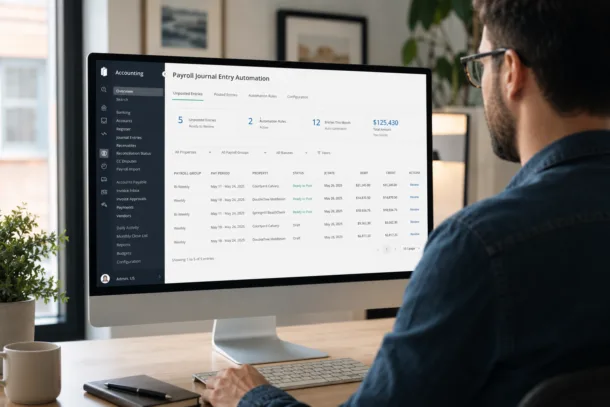
One of the highest-value outcomes of hotel accounting and labor integration is the automation of payroll journal entries. When labor data flows directly into the accounting system, the payroll journal entry, which records total wages, tax liabilities, and net pay across all departments and GL accounts, can be generated automatically from the labor system’s data rather than built manually by an accountant.
Manual payroll journal entries are time-consuming, error-prone, and often built from summary data that lacks the department-level detail needed for accurate reporting. Automated journal entries built from integrated labor data are faster, more detailed, and more accurate.
The automation also extends to accruals. When the accounting system knows exactly how many hours were worked and at what rates through any point in the pay period, it can calculate the wage accrual for days worked but not yet paid with precision rather than estimation.
What Breaks Without Integration
Management companies that operate without labor-accounting integration face predictable problems:
- Month-end close takes longer because labor costs must be manually compiled and entered
- Department P&Ls contain estimated rather than actual wage costs until payroll is processed
- Payroll journal entries require manual reconciliation against the labor register
- Accruals for wages earned but not paid are estimated rather than calculated
- Department-level variance analysis is less reliable because wage allocations are approximated
- Financial reports distributed to ownership groups may contain labor costs that do not match the operational reality managers observe
These problems compound as portfolio size increases. A management company with three properties can manage manual labor-accounting workflows with significant effort. A management company with twenty properties cannot.
Inn-Flow: Hotel Accounting and Labor Integration Built In
Inn-Flow’s hotel accounting software and hotel labor management are part of a single integrated platform. Labor data flows automatically into the general ledger, department wage allocations happen without manual intervention, and payroll journal entries are generated from labor system data. The result is more accurate department-level P&Ls, faster close cycles, and financial reports that management companies can distribute to ownership groups with confidence.
See how Inn-Flow’s integrated platform works at inn-flow.com/system-overview.
Frequently Asked Questions
Why do hotel accounting and labor systems need to integrate?
Without integration, labor costs flow into accounting through manual transfers that are slow, error-prone, and often insufficiently detailed for department-level P&L analysis. Integration makes department wage allocation automatic and payroll journal entries accurate.
What data flows from a hotel labor system to accounting?
Hours worked by department and pay classification, wage rates, overtime and holiday hour breakdowns, department assignments for split-shift workers, and benefit cost allocations where applicable.
How does labor-accounting integration improve hotel financial reporting?
Integration produces department-level P&Ls that reflect actual labor costs rather than estimated or manually transferred figures. It also enables faster close cycles because labor cost data does not need to be manually compiled at month-end.
Can payroll journal entries be automated with hotel labor-accounting integration?
Yes. When labor data flows directly into the accounting system, payroll journal entries can be generated automatically from labor system data, including accurate department-level wage allocations and calculated accruals for wages earned but not yet paid.
What problems arise from operating without hotel labor-accounting integration?
Longer close cycles, estimated accruals rather than calculated ones, department P&L errors from approximate wage allocations, and financial reports that require manual reconciliation before they can be distributed to ownership groups.