Key Takeaways
- Owners make high-stakes decisions based on financial reports. Inaccurate or delayed reporting erodes trust.
- The most important financial decisions owners make — selling, refinancing, reinvesting — all require reliable NOI and EBITDA data.
- Management companies that produce clean, timely, ownership-ready accounting are significantly more likely to retain management contracts.
- Owner reporting requirements go beyond a monthly P&L — they include budget vs. actual, capital tracking, and trend analysis.
- Daily bookkeeping accuracy is the prerequisite for ownership-quality financial reporting.
Hotel owners are ultimately financial investors. Whether they own one property or fifty, their decisions — when to sell, when to refinance, when to invest in a renovation, and whether to keep or replace their operator — are driven by financial data. The quality of that data depends entirely on the quality of the accounting behind it. Hotel accounting software that is accurate, timely, and structured for ownership-facing reporting is not a back-office detail. It is a core competitive capability for management companies.
What Decisions Owners Make From Accounting Data
Hotel owners face a range of consequential decisions that require reliable financial information. Each of these decisions is only as good as the accounting data that informs it.
Capital Allocation
Owners with multiple properties must decide where to invest additional capital — in renovations, FF&E upgrades, or property improvements. Those decisions require understanding which properties are generating strong returns, which are declining, and which have near-term capital needs that will affect future performance.
Refinancing
Lenders underwrite hotel loans based on NOI and EBITDA. When an owner refinances, the accuracy and completeness of the financial record determines loan terms. A property with disorganized or inconsistently reported financials will face a more difficult underwriting process, potentially at less favorable terms.
Property Sale
Buyers evaluate hotels based on trailing financial performance. Clean, auditable, USALI-compliant financials support a stronger valuation and a smoother due diligence process. Properties with accounting gaps, inconsistencies, or delayed records create uncertainty that buyers discount.
Operator Selection and Retention
Owners evaluate management companies largely on financial results and reporting quality. A management company that delivers accurate, timely, well-structured financial packages is demonstrating operational competence. One that produces late, confusing, or inconsistent reporting raises questions about the quality of the underlying management.
The Reporting Package Owners Expect
A standard ownership reporting package typically includes the following components:
- Monthly P&L against budget: total revenue, departmental margins, undistributed expenses, GOP, and NOI — all compared to the approved budget with variance explanations.
- Year-to-date summary: cumulative performance against the annual budget.
- RevPAR and occupancy statistics: revenue metrics from the PMS alongside financial results.
- Labor cost summary: total labor expense, labor percentage, and comparison to budget by department.
- Capital expenditure tracking: actual CapEx spend vs. approved budget, reserve for replacement balance, and upcoming capital needs.
- Accounts receivable and payable aging: outstanding balances and any exposures.
- Prior-year comparison: context for whether current performance represents improvement or decline.
Most ownership groups expect this package within 10 to 15 business days after month-end. Packages delivered outside that window signal either accounting inefficiency or a close process that needs structural improvement.
How Accounting Quality Affects Owner Confidence
Owner confidence is built over time through consistent delivery of accurate, timely, well-explained financial information. It erodes when reports are late, when numbers change between drafts, when explanations for variances are absent, or when the accounting does not reconcile clearly to the PMS data owners can see elsewhere.
The quality of the underlying bookkeeping — daily transaction posting, proper expense coding, timely bank reconciliation — is what determines whether month-end reporting is a smooth process or a scramble. Management companies that treat bookkeeping as a low-priority task often discover that their reporting quality reflects that priority.
Owners who receive inconsistent or unreliable reporting begin to question not just the accounting but the operation overall. If the financial records are disorganized, what does that say about how the property is being managed day to day?
What Ownership-Ready Accounting Looks Like
Ownership-ready accounting has several defining characteristics:
- USALI compliance: The Uniform System of Accounts for the Lodging Industry provides the standardized framework that owners, lenders, and buyers all understand.
- Consistent chart of accounts: The same coding structure applied month over month and, for management companies, property over property.
- Current and reconciled books: Transactions posted within the period they occur, bank accounts reconciled, and intercompany items cleared.
- Clear variance explanations: Budget variances explained in writing, not just displayed as numbers.
- Audit-ready documentation: Supporting documentation retained and organized so that lender reviews, audits, or due diligence can be satisfied without a multi-week reconstruction effort.
How Management Companies Use Reporting to Retain Owners
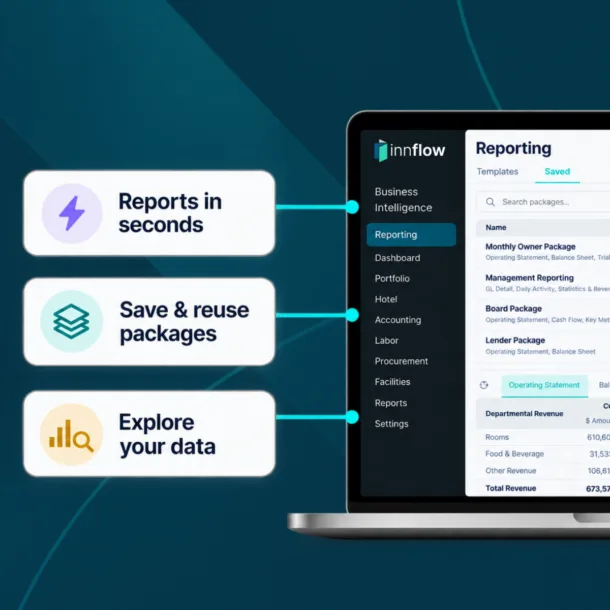
Management companies that invest in reporting quality gain a competitive advantage in owner retention. Owners who receive excellent financial information from their operator are less likely to entertain competing proposals and more likely to add properties to the management contract. Business intelligence dashboards that give ownership groups real-time access to property performance data take this dynamic even further.
When owners can see current RevPAR, labor cost percentage, and budget variance without waiting for a monthly package, the relationship shifts from periodic accountability to continuous transparency. That transparency — when the underlying performance is strong — becomes a retention tool in itself.
Management companies can differentiate themselves by offering owners:
- Proactive communication about variances before formal reports are delivered
- Read-only dashboard access to current property performance
- Quarterly trend reviews beyond the standard monthly package
- CapEx scenario modeling tied to actual financial performance
Common Accounting Gaps That Undermine Owner Confidence
The most frequent accounting failures in hotel management companies that affect owner confidence include:
- Late reporting: packages delivered beyond the 10-15 day window without explanation.
- Restated numbers: prior-period financials that change after submission without clear explanation.
- Missing reconciliations: bank accounts or balance sheet items that are not regularly reconciled.
- Inconsistent coding: expense categories that shift between periods, making trend analysis unreliable.
- Inadequate explanations: variance reports that show numbers without context or narrative.
- Surprise capital calls: CapEx needs that appear without prior communication or budget documentation.
Every late report or unexplained variance is a small withdrawal from the trust account. Management companies that make too many withdrawals eventually find themselves facing an owner who is ready for a change.
How Inn-Flow Supports Ownership-Quality Accounting
Inn-Flow’s hotel accounting software is built for the operational and reporting demands of hotel management companies. USALI-aligned chart of accounts, automated reconciliation tools, and integrated BI reporting allow management companies to produce ownership-quality financial packages consistently and on schedule.
From daily bookkeeping through month-end close and owner reporting, Inn-Flow provides the infrastructure that supports confident, transparent ownership relationships.
Contact Inn-Flow to learn how the platform can improve your financial reporting quality and strengthen your owner relationships.
Frequently Asked Questions
How soon after month-end should ownership reports be delivered?
Most ownership groups expect reporting packages within 10 to 15 business days after month-end. Management companies that consistently deliver within this window demonstrate operational efficiency. Those that routinely deliver late face growing owner skepticism about the quality of their financial management.
What financial data do hotel buyers look for during due diligence?
Hotel buyers typically want three to five years of audited or reviewed P&L statements, USALI-compliant financials, occupancy and rate history, capital expenditure records, existing management and franchise agreements, and any material vendor contracts. Clean, organized records accelerate due diligence and support stronger valuations.
Can owners access hotel financial data directly?
Yes, many management companies now provide owners with read-only access to BI dashboards that show current property performance. This is increasingly expected by sophisticated ownership groups and is a differentiating capability for management companies that can offer it.
Why does USALI compliance matter for hotel ownership reporting?
USALI provides a standardized financial reporting framework that owners, lenders, buyers, and operators all understand. Compliance means that financial statements are organized and labeled consistently with industry conventions, making them easier to interpret, compare, and rely on for decisions.
What is the most common cause of ownership reporting failures in hotel management companies?
The most common cause is bookkeeping delays at the property level. When daily transaction posting is inconsistent, the month-end close process becomes a catch-up exercise rather than a verification exercise. The result is late, error-prone reporting that erodes owner confidence.