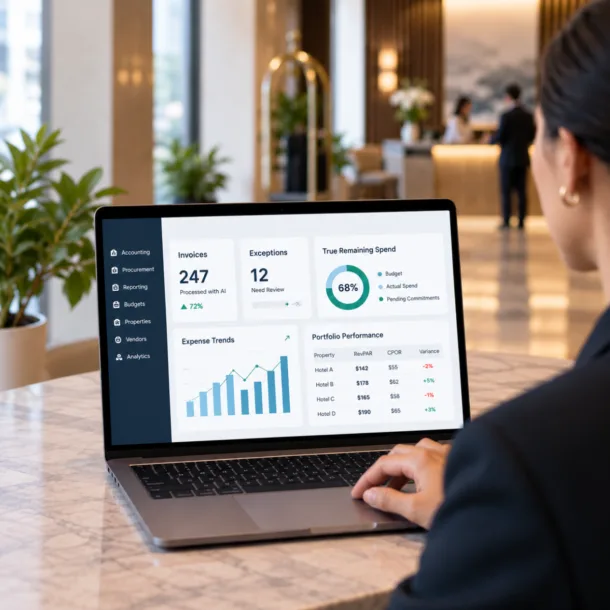
Hotel finance leaders want AI to do more of the manual work. They don’t necessarily want it making more of the decisions.
That distinction came through clearly in Inn-Flow’s recent research on AI adoption in hospitality. Seventy-two percent of hoteliers surveyed cited reducing manual work as the primary value of AI. At the same time, 87% ranked trust as the number-one factor in AI adoption, and 68% said they need to understand how AI reaches its conclusions.
Those findings point to a more nuanced vision for the future of hotel accounting.
Hoteliers want AI to take work off their teams’ plates. They also want to know what it’s doing, why it’s doing it, and when a person needs to step in.
The future of hotel accounting isn’t zero oversight. It’s zero wasted oversight.
Automate the work. Keep the visibility.
There is no shortage of repetitive work in hotel accounting.
Invoices have to be captured and coded. Transactions have to be categorized. Accounts have to be reconciled. Variances have to be identified. Across a multi-property portfolio, those processes can consume hours that experienced finance professionals could spend analyzing performance, solving problems, and supporting operators.
These are exactly the kinds of workflows where AI and automation can have an immediate impact.
Consider invoice processing. AI can capture information from an invoice and suggest the appropriate GL coding instead of requiring someone to enter every field manually. In reconciliation, technology can handle routine matching and surface the discrepancies that require investigation.
The person hasn’t disappeared from either process. Their role has changed.
Instead of spending their attention equally on every transaction, they can focus it on the transactions that actually warrant attention.
As Inn-Flow Chief Product Officer Lee Bridges puts it, “AI should speed up your workflows, not remove your visibility into them.”
What if your team only had to review what actually needed reviewing?
This is where the potential of AI in hotel accounting becomes more interesting.
Much of the traditional accounting process requires people to review large amounts of perfectly normal activity in order to find the relatively small amount that isn’t normal.
AI can begin to reverse that equation.
Imagine a hotel management company overseeing dozens of properties. Labor costs at one property suddenly go above the expected amount. A reconciliation doesn’t match. Actual expenses begin moving materially away from the forecast. A portfolio-level KPI starts trending in the wrong direction.
Instead of waiting for someone to find those issues during a scheduled review, AI can help surface them as they emerge. The result is more targeted oversight.
That same principle can apply before a transaction even reaches accounting.
Consider a purchasing decision. Traditionally, a hotel may place an order, receive the invoice days later, manually match it, and only discover the resulting variance during a later financial review. By the time finance has visibility, the decision has already been made.
Connecting Procurement and Accounting can move that financial context upstream.
With Inn-Flow’s AI-enabled Procurement and Accounting integration, buyers can see True Remaining Spend — incorporating budget and forecast data, actual spend, and pending purchase commitments — as they make purchasing decisions. When an order is placed, the commitment is reflected immediately. When the invoice arrives and is matched to the purchase order, the actual cost replaces that commitment.
AI can also use purchasing context — including products, vendors, prices, and rules — to surface better-priced or more appropriate alternatives while the buyer works. But the recommendation remains exactly that: a recommendation. The buyer reviews it and decides whether to make the change.
That’s an important distinction. Technology doesn’t have to take control away from the person making the decision to create more financial control for the business.
And that’s the larger opportunity behind exception-based accounting: finance teams spend less time searching for problems and more time deciding what to do about them.
But AI needs context to know what’s unusual.
There is a catch.
An anomaly is only useful if the technology identifying it understands what “normal” looks like in the first place.
That is particularly important in hospitality.
Hotels operate with industry-specific financial structures and performance measures. Finance teams need to understand results across properties, departments, ownership groups, vendors, and operating periods. Metrics like RevPAR and CPOR carry specific meaning. USALI provides a financial framework particular to the industry.
A generic AI model doesn’t inherently understand that context.
In fact, 81% of hoteliers in Inn-Flow’s research said generic AI tools don’t fit hotel operations.
That helps explain why the foundation underneath AI matters as much as the AI itself.
When accounting and operational data are fragmented across systems, AI sees fragments too. The differentiator isn’t simply having AI; it’s what the AI can see.
Give it connected financial and operational context, and technology has a much stronger foundation for identifying meaningful patterns, detecting exceptions, and surfacing recommendations someone can actually act on.
And the opportunity goes beyond understanding what has already happened.
Connecting data across accounting, labor, payroll, procurement, and relevant third-party sources creates the opportunity to look forward, too. Historical performance can inform forecasts. Current trends can signal where results may be heading. And emerging issues can become opportunities to act today rather than explain what happened after the fact.
That’s the larger promise of a connected back office: less time finding answers and more time acting on them.
AI doesn’t make fragmented data trustworthy simply by sitting on top of it. Its value grows when the information underneath it provides enough context to turn a signal into a decision.
AI should help finance teams ask better questions.
There is a tendency to measure the promise of AI in terms of how much human involvement it can eliminate.
For hotel finance teams, a more useful measure may be how much human attention it can redirect.
If technology can handle routine invoice capture and coding, what can an accountant do with that time?
If a reconciliation mismatch is surfaced automatically, how much sooner can the underlying issue be resolved?
If a labor-cost anomaly is identified before the end of the reporting period, what decision can an operator make today instead of next month?
If financial context reaches a buyer before a purchase is made, how many variances could be prevented rather than explained later?
If portfolio-level trends surface automatically, what questions can a CFO spend time answering instead of compiling the information needed to ask them?
Those are not examples of people becoming less important to hotel accounting. They’re examples of expertise being applied where it matters more.
The future isn’t zero oversight. It’s zero wasted oversight.
AI will almost certainly reduce the amount of manual work required to run the hotel back office. It already is.
But automation and control don’t have to exist on opposite ends of a spectrum.
The better opportunity is to automate what is predictable, surface what isn’t, and give hotel finance teams the context they need to make the decisions technology can’t make for them.
That means fewer hours spent touching routine transactions simply because that’s how the process has always worked. Fewer problems discovered after they’ve had time to compound. More opportunities to act before a financial decision becomes a financial result. And less time spent hunting through disconnected information to understand what is happening across a portfolio.
The finance team stays in control.
They just don’t have to look at everything to get there.
Frequently Asked Questions
How is AI being used in hotel accounting?
AI can help hotel accounting teams automate repetitive tasks such as invoice capture, GL coding, transaction categorization, reconciliation, variance detection, and financial analysis. It can also surface anomalies and exceptions so finance teams can focus their attention on the transactions and trends that require human judgment.
Will AI replace hotel accountants?
AI is more likely to change how hotel accountants spend their time than eliminate the need for them. By automating predictable, repetitive work and surfacing exceptions, AI can allow finance professionals to spend more time analyzing performance, investigating issues, supporting operators, and making strategic decisions.
What is exception-based accounting?
Exception-based accounting is an approach in which technology handles or monitors routine financial activity and directs human attention to unusual transactions, discrepancies, variances, or trends. Instead of reviewing every transaction equally, finance teams can focus on the activity that actually requires investigation or a decision.
Why is human oversight still important when using AI in hotel accounting?
AI can identify patterns, automate workflows, and make recommendations, but hotel finance teams still need visibility into how financial information is being handled and the ability to review exceptions and make decisions. Effective AI should reduce unnecessary manual oversight without removing human control.
Why does hospitality-specific context matter for AI?
Hotel operations involve industry-specific financial structures, metrics, and workflows, including measures such as RevPAR and CPOR and accounting frameworks such as USALI. AI is more useful when it can interpret information within that hospitality context rather than analyzing isolated data without understanding how a hotel or portfolio operates.
Why does connected data matter for AI in hotel finance?
AI can only work with the information available to it. When accounting, labor, payroll, procurement, and other operational data are fragmented across systems, AI has limited context for identifying meaningful patterns. Connecting that data can give AI a stronger foundation for detecting exceptions, identifying trends, and surfacing actionable insights.
How can connecting Procurement and Accounting improve financial control?
Connecting Procurement and Accounting can give buyers financial context before a purchasing decision is finalized. For example, Inn-Flow’s integration can incorporate budget and forecast data, actual spend, and pending purchase commitments into True Remaining Spend, helping teams understand the financial impact of a purchase while they are making it rather than after an invoice reaches accounting.
Can AI help hotels prevent budget variances?
AI and connected financial systems can help teams identify potential issues earlier, but they cannot prevent every variance. By surfacing spending trends, anomalies, purchasing commitments, and other financial signals sooner, technology can give hotel teams more opportunities to act before an emerging variance becomes a larger problem.
What should hotel finance leaders look for when evaluating AI accounting tools?
Hotel finance leaders should look beyond whether a platform simply offers AI. Important considerations include the quality and breadth of the data the AI can access, its understanding of hospitality-specific workflows, transparency into recommendations and outputs, integration with existing financial and operational processes, and the ability for users to maintain control over important decisions.
What is the goal of AI in the hotel back office?
The goal should not simply be to remove people from financial processes. The greater opportunity is to reduce repetitive work, surface what needs attention, and give hotel teams better context for making decisions. In other words: automate what is predictable, identify what isn’t, and direct human expertise where it matters most.