A hotel budget is supposed to guide how money gets spent but too often, the budget doesn’t factor into the purchase until after the decision has already been made.
A GM places an order. The invoice arrives days later. Accounts payable processes it, and eventually, the expense reaches the P&L, where finance can compare actual spend against the budget. However, by the time that financial impact is visible, the purchase has already been made and the money is committed. Finance can see what happened, but there’s little opportunity to change the outcome.
That’s the limitation of treating purchasing and accounting as separate workflows: financial visibility happens after the financial decision.
A better model moves that context upstream. The budget should guide the purchase, not explain it later.
Every cart is a financial decision
It’s easy to think of purchasing as an operational process. A hotel needs something, someone finds the product, chooses a vendor, gets the necessary approval, and places the order. Accounting comes into the picture later.
But the financial impact doesn’t begin when an invoice reaches AP. It begins when the buyer decides what to put in the cart.
Across a hotel portfolio, those decisions multiply quickly. More properties mean more buyers, vendors, purchase orders, invoices, approvals, GL codes, and exceptions.
At a certain point, corporate finance simply cannot manually oversee every purchasing decision.
That doesn’t mean finance should give up control. It means control has to become part of the purchasing workflow itself.
What if the budget showed up before checkout?
Imagine you’re a GM building an order for your property. You know you have a budget, and you may know roughly where you stand against it. But do you know exactly how much is still available once you account for expenses that have already posted and purchases that have been committed but haven’t reached the P&L yet?
That’s where purchasing and accounting become much more powerful together.
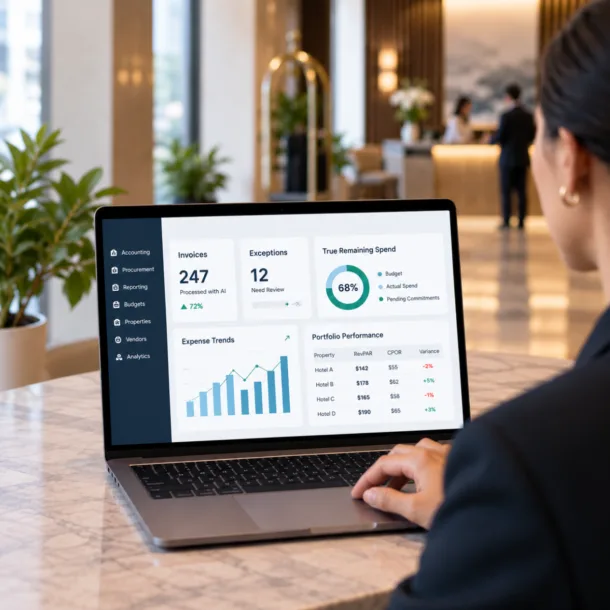
With Inn-Flow’s Procurement and Accounting integration, True Remaining Spend brings budget and forecast data, actual spend, and pending purchase orders into the purchasing experience. The person making the purchase can see what’s actually available while the cart is still being built.
When an order is placed, the pending purchase order is reflected immediately. When the invoice arrives later later arrives and is matched to that PO, the commitment clears and the actual cost takes its place. Instead of waiting for accounting to reveal the impact of a purchasing decision, the financial context is available while there’s still time to make a different one.
In other words, cost control moves from the close to the point of purchase.
AI gets more useful when it knows what you’re trying to protect
Connecting purchasing and accounting also changes what AI can contribute to the process.
Price comparison on its own isn’t particularly complicated. An AI tool can look across products and vendors and identify a less expensive option. But the cheapest item isn’t necessarily the right recommendation.
A hotel buyer is making a decision within a much larger set of constraints: available budget, existing commitments, purchasing standards, approval rules, product specifications, and the needs of the property. That’s why the more interesting question isn’t simply whether your procurement software uses AI, but how it uses AI.
Inn-Flow’s AI Cart Optimizer scans connected vendors and surfaces better-priced or more appropriate alternatives while a buyer is building a cart. Because Procurement and Accounting are connected, that purchasing workflow can also include financial context such as True Remaining Spend and open purchase commitments.
Better control doesn’t have to mean more approvals
As hotel companies grow, finance leaders naturally want stronger purchasing controls. At the same time, operators don’t want every order slowed down by another layer of corporate approval.
The answer can’t be asking finance to manually review thousands of purchasing decisions. It also can’t be giving every property complete autonomy and waiting until month-end to see what happened. Connected workflows offer another option: build more of the guardrails into the decision itself.
Budget and forecast data establish the plan, while True Remaining Spend shows the buyer where they stand against it. Purchasing standards and approvals can flag items that need additional review, and AI can surface alternatives while the buyer is already working. When the invoice arrives, matching connects the purchase back to the accounting outcome.
The result is a way for the buyer to keep buying and finance to maintain control without either team having to recreate the other’s work.
As the portfolio grows, the model matters more
At one property, a purchasing decision can affect margin. Across five, ten, or twenty-five properties, the same purchasing process becomes an operating model.
Every additional hotel introduces more people making decisions and more opportunities for purchasing practices to diverge. Different GMs may use different vendors. Coding can become inconsistent. Approvals become harder to manage. And more cleanup can ultimately land on finance.
At scale, the challenge is whether that policy can govern thousands of decisions without requiring corporate to review thousands of decisions.
Instead of scaling oversight at the same rate as the portfolio, hotel companies can scale the financial context and guardrails available to the people making purchases. A GM shouldn’t need a finance person standing over their shoulder to make an informed purchasing decision; the information they need should be built into the workflow.
From reporting spend to influencing it
Financial systems have traditionally been very good at answering an essential question: What happened?
Accurate books and reliable reporting will always matter. But connecting purchasing decisions to financial data creates an opportunity to answer another question earlier in the process: What can we still change?
A variance discovered during close can be explained. A budget risk identified while someone is building a cart can potentially be prevented. Similarly, a more cost-effective purchasing option surfaced after an invoice arrives may be interesting, but the same option surfaced before the buyer places the order is actionable.
The budget should guide the purchase, not explain it later
Every cart contains dozens of seemingly small decisions: which product, which vendor, how much to buy, whether the item meets standards, whether there’s a better option, and, crucially, whether the purchase still makes sense against the financial plan.
Those decisions shouldn’t exist separately from the accounting system that will eventually record their impact.
When Procurement and Accounting share the same financial reality, the budget stops being something teams look back at after the money has been spent. It becomes part of the decision itself.
That’s the opportunity of a connected hotel back office: not simply knowing what something costs sooner, but giving hotel teams the context to make a better decision while they can still change it.
Because every cart is a cost decision.
Frequently Asked Questions
Why should hotel procurement and accounting be connected?
Connecting procurement and accounting gives hotel teams financial context earlier in the purchasing process. Instead of waiting for an invoice to reach accounts payable and eventually appear on the P&L, buyers can understand how purchasing decisions affect the budget while they are still building an order. This helps finance maintain stronger cost control while giving operators the information they need to make better purchasing decisions.
What is True Remaining Spend?
True Remaining Spend gives hotel teams a more complete picture of what is actually available to spend by considering the budget or forecast, actual expenses, and purchase commitments that have not yet reached the P&L. This helps prevent a property’s available budget from appearing higher simply because recent purchase orders have not yet been invoiced.
Why aren’t actual expenses enough to understand remaining hotel budget?
Actual expenses only reflect costs that have already been recorded. A hotel may also have open purchase orders representing money that has effectively been committed but has not yet appeared as an actual expense. Accounting for both actual spend and pending commitments gives operators and finance teams a more accurate view of what remains available.
How does integrating procurement and accounting improve hotel cost control?
An integrated workflow moves cost control closer to the point of purchase. Budget and forecast data can provide financial guardrails, open purchase orders can be reflected as commitments, approvals can flag purchases that require additional review, and AI can surface alternative products or vendors before an order is placed. That gives teams an opportunity to influence spend rather than simply report on it later.
Can hotels improve purchasing controls without adding more approvals?
Yes. Stronger purchasing control does not necessarily require finance to manually approve every order. Hotels can build financial context, purchasing standards, approval rules, and other guardrails directly into the procurement workflow. This allows operators to make informed decisions independently while giving finance greater consistency and visibility across the portfolio.
How can AI improve hotel procurement?
AI can help hotel buyers compare products and vendors and identify better-priced or more appropriate alternatives while they are building an order. Its value increases when those recommendations exist within a broader purchasing workflow that also considers factors such as budget availability, open commitments, purchasing standards, approvals, and property needs.
Why does procurement and accounting integration become more important as a hotel portfolio grows?
As a portfolio expands, the number of buyers, vendors, purchase orders, invoices, approvals, and coding decisions grows with it. Manually overseeing every purchasing decision becomes increasingly difficult. Connecting procurement and accounting allows hotel companies to scale consistent financial context and purchasing guardrails across properties without requiring corporate finance to review every transaction.
How do Inn-Flow Procurement and Accounting work together?
Inn-Flow connects purchasing activity with accounting data so hotel teams can make decisions using a shared financial picture. True Remaining Spend incorporates budget or forecast data, actual expenses, and open purchase commitments into the purchasing experience. When a purchase order is placed, the commitment is reflected; when the invoice is later matched to that PO, the commitment clears and the actual expense takes its place.
What is the benefit of showing budget information during the purchasing process?
Showing budget information while a buyer is building a cart makes the financial plan actionable. Instead of discovering a budget variance after the purchase has already been made, the buyer can see potential budget pressure while there is still an opportunity to adjust quantities, choose an alternative product, select another vendor, or reconsider the purchase.
How does connected hotel back-office software help finance and operations work together?
Connected back-office software reduces the need for finance and operations teams to recreate or reconcile one another’s work. Operators can access relevant financial context within their purchasing workflow, while finance gains greater consistency and visibility into purchasing activity. The result is a shared process in which the budget can help guide spending decisions before the money is committed.