What Financial Visibility Means for GMs
Financial visibility for a hotel GM means having access to real-time or near-real-time data about the property’s financial position — labor costs versus budget, revenue performance, department-level expense tracking, and comparison against prior periods. This data should be available in a format a GM can actually use, not just as a dense accounting report that requires a controller to interpret. Hotel business intelligence dashboards designed for operator-level users present this data in a way that supports operational decisions rather than financial analysis.
The distinction between financial visibility and financial reporting matters. A monthly P&L is financial reporting. Real-time financial visibility means a GM can look at their labor cost position on a Tuesday and know whether they are tracking to budget for the week — not find out at month-end that they were 15 percent over.
Management companies that treat financial visibility as a controller’s tool rather than a GM’s tool are leaving significant management capacity on the table.
What GMs Need Daily
Daily financial visibility for a GM does not require a full accounting package. It requires a small set of high-signal metrics that connect to the decisions a GM makes every morning:
- Prior-day occupancy and revenue versus forecast.
- Labor hours scheduled versus labor hours worked for the previous shift.
- Overtime alerts by department.
- Open purchase orders or pending invoice approvals that need attention.
- Guest service exception flags that have a cost dimension.
These metrics take minutes to review when they are presented clearly. They inform the GM’s daily standup with department heads, their scheduling adjustments for the day ahead, and their communication with the management company’s finance team about anything unusual.
What GMs Need Weekly
Weekly financial data is where hotel accounting platform data becomes directly actionable for GMs. At the weekly level, the key metrics are:
- Labor cost actuals versus budget by department for the current week and the rolling month-to-date.
- Revenue pacing versus budget for the current period.
- Expense actuals versus budget by department — flagging departments that are running significantly above or below.
- Accounts payable aging: any past-due items that need resolution before they affect vendor relationships.
- Any variance flag from the accounting team that requires GM context or explanation.
The weekly review is where proactive management happens. A GM who sees that housekeeping labor is running 8 percent above budget in week two of the month can adjust staffing for the remaining weeks. A GM who only finds out at month-end that housekeeping was over budget cannot do anything about it.
How Visibility Improves GM Decisions
The decisions GMs make that are most improved by financial visibility:
Staffing Decisions
Labor is the largest controllable cost, and scheduling decisions made without real-time hotel labor management data are effectively guesses. GMs who can see current-week labor tracking against budget adjust schedules proactively. Those who cannot adjust reactively — or not at all.
Purchasing Decisions
GMs approve purchases and requisitions throughout the month. Without financial context, these approvals are made on individual merit rather than in the context of the department’s overall budget position. Financial visibility allows GMs to evaluate whether a purchase is appropriate given the current budget status.
Vendor Relationship Decisions
When GMs have visibility into accounts payable aging and vendor contract terms, they can manage vendor relationships proactively — addressing past-due items before they affect service or pricing rather than being surprised by a vendor escalation.
Owner Communication
GMs who understand their property’s financial position have better conversations with owners. They can explain variances with context rather than being caught unprepared by a question about the month-end report. Owner confidence in the GM team is partly a function of whether the GM can speak to the financial performance of the property fluently.
The GM Financial Accountability Model
Financial accountability for GMs is most effective when it is paired with the tools to act on the accountability. Holding a GM responsible for a labor cost ratio without giving them real-time labor cost data is accountability without agency — it generates frustration rather than performance improvement.
The effective GM financial accountability model looks like this:
- Clear financial targets: department-level cost ratios, revenue floors, and key operational metrics with defined acceptable ranges.
- Real-time access to financial data in a format the GM can use operationally.
- Regular review cadence: daily check of key metrics, weekly financial review with the corporate team, monthly P&L review with department heads.
- Escalation path for variances: a clear process for when the GM needs to flag a developing variance to the management company before it compounds.
Management companies that build this model into their property management approach see better financial adherence and fewer month-end surprises than those that treat financial accountability as a month-end event.
What Happens Without Visibility
GMs without financial visibility are not necessarily less capable — they are working with less information. The predictable consequences:
- Labor cost overruns that are not caught until month-end and cannot be corrected retroactively.
- Purchasing decisions made without budget context that compound into expense overruns.
- Reactive communication with owners about variances the GM was not aware of until the P&L arrived.
- Missed opportunities to make proactive service investments when the budget is in a positive position.
- Difficulty building credibility with the management company finance team because the GM cannot speak to financial performance with specificity.
Inn-Flow Gives GMs Financial Visibility
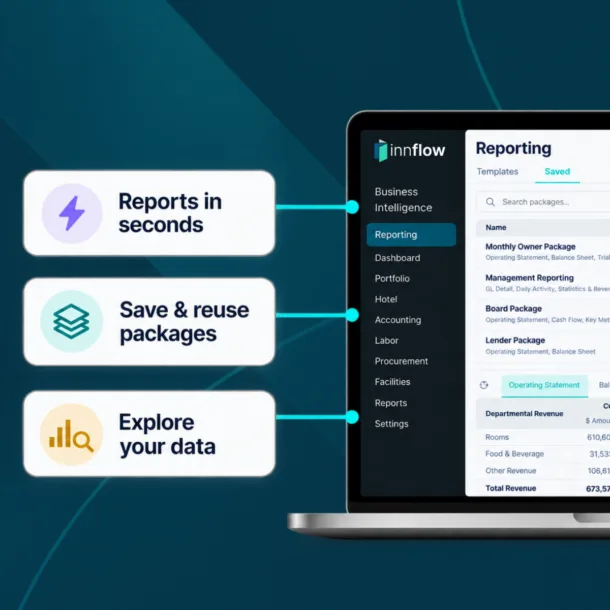
Inn-Flow’s dashboard layer is designed for operational users — not just accountants. GMs get a clear view of their property’s labor cost position, revenue performance, and expense tracking in real time, without needing to pull reports from the accounting system. See how Inn-Flow delivers financial visibility for hotel GMs or contact us to discuss how the platform works in a multi-property management environment.
Frequently Asked Questions
What financial metrics are most important for hotel GMs?
Labor cost versus budget by department, revenue versus forecast, expense tracking by department, and accounts payable aging are the most operationally relevant daily and weekly metrics for GMs.
How often should hotel GMs review financial data?
Daily for labor cost and revenue pacing. Weekly for full department budget review. Monthly for complete P&L review with department heads and the management company finance team.
Can hotel GMs access accounting data in real time?
Yes, when the property is on a platform that provides operator-facing dashboards connected to the accounting general ledger. Real-time access requires both the right data architecture and a user interface designed for operational rather than accounting users.
Why do management companies restrict GM access to financial data?
Historically, financial systems were not designed for operational users and access control was a practical necessity. Modern platforms designed for multi-property management can provide role-appropriate financial visibility without exposing sensitive information inappropriately.
How does GM financial visibility affect owner relationships?
GMs with financial visibility can speak to property performance with specificity and context. Owners respond positively to GMs who understand the financial picture of their property and can explain variances proactively. This builds trust and supports contract renewal.