Key Takeaways
- AI in hotel accounting is a workload reduction tool, not a replacement for financial expertise.
- Invoice GL coding automation is the most mature and widely deployed AI use case in hospitality finance.
- Anomaly detection reduces the risk that reconciliation errors go unnoticed until month-end.
- AI-assisted variance analysis surfaces deviations earlier and with more context than manual review.
- AI claims from vendors should be evaluated against specific use cases, not broad capability statements.
What AI Actually Does Today vs. the Hype
The hospitality software market has produced a lot of marketing language around AI in the last two years. Vendors describe their platforms as AI-powered, intelligent, or machine-learning-driven without always specifying what that means in practice. Evaluating AI in hotel accounting requires cutting through the language and asking what the AI actually does, in which workflow steps, and with what accuracy.
The honest picture of AI in hotel accounting today is that it is genuinely useful in a narrow set of high-volume, pattern-dependent tasks. Invoice coding is the clearest example. Reconciliation anomaly detection is another. Budget variance analysis is a third. Beyond those, most of what gets marketed as AI is better described as rules-based automation or workflow orchestration.
This is not a criticism — rules-based automation that reduces manual work is valuable. But management companies evaluating AI features should ask vendors to demonstrate the specific model, the training data, the accuracy rate, and the workflow integration before buying based on AI marketing claims.
AI-Assisted Invoice GL Coding
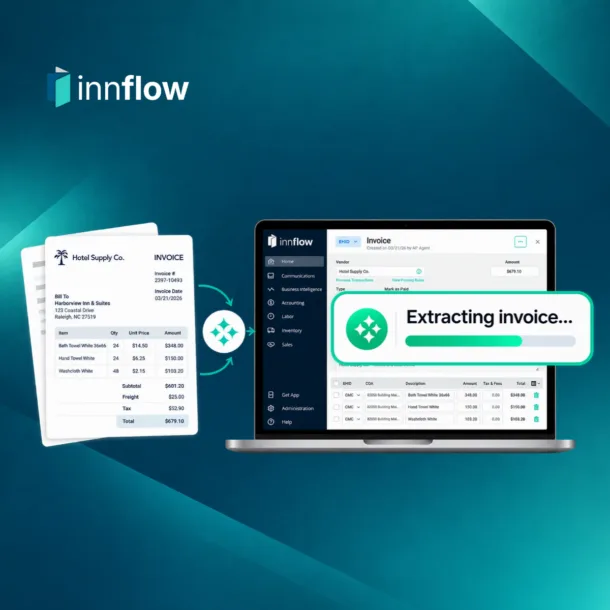
The most operationally impactful AI application in hotel accounting is automated GL coding for accounts payable invoices. In a typical multi-property portfolio, hundreds of invoices are processed each month across departments. Each invoice needs to be coded to the correct general ledger account and cost center before it can be approved and posted. On a hotel accounting platform with AI coding, this step is handled automatically for the majority of invoices based on vendor history, invoice line item data, and learned patterns from prior coding decisions.
How it works in practice:
- The AI model analyzes the vendor, invoice amount, line item descriptions, and prior coding patterns.
- It assigns a GL code and cost center with a confidence score.
- High-confidence suggestions are applied automatically or with a single-click confirmation.
- Low-confidence or unusual invoices are flagged for manual review.
The practical effect is that the AP team spends less time on routine coding and more time on the exceptions that actually require judgment. For a controller managing 10 or more properties, this can meaningfully reduce the per-invoice time cost of the AP process.
Accuracy is the critical variable. AI coding models that have been trained on a large and diverse hospitality dataset perform significantly better than generic models or models trained on a narrow sample. When evaluating vendors, ask for the average coding accuracy rate across their customer base and what the review and correction workflow looks like when the model gets it wrong.
AI-Powered Reconciliation Anomaly Detection
Reconciliation in hotel accounting involves comparing multiple data sources: the PMS daily revenue summary, the accounting general ledger, the bank statement, the credit card processor reports, and the POS system for food and beverage properties. In a clean close, all of these reconcile within acceptable tolerances. In practice, discrepancies appear regularly.
Traditional reconciliation processes catch discrepancies when someone manually compares the reports — which typically happens at month-end, when time pressure is highest and discrepancies have had a full month to compound.
AI anomaly detection identifies statistical deviations from expected patterns as they occur, rather than waiting for manual review. If a revenue figure is unexpectedly high or low for a given day and property type, or if an account balance moves outside its historical range, the system flags it for review while there is still time to investigate and correct.
The practical value is earlier error detection, which means less time spent on month-end investigation and fewer surprises in the owner report package.
AI in Budget Variance Analysis
Budget variance analysis is one of the most time-consuming parts of the monthly close and owner reporting process. Controllers typically compare actuals to budget line by line, identify significant variances, and then write narrative explanations for the owner report. This process requires pulling data from the accounting system, organizing it by department, and interpreting the drivers of each variance. Business intelligence tools with AI assistance can surface significant variances automatically — flagging which department, which account, and which time period shows the largest deviations from plan.
What AI contributes to variance analysis:
- Automated identification of statistically significant variances — not just dollar amount, but variance relative to revenue, prior year, and comparable properties.
- Pattern recognition that distinguishes one-time variances from trend-level shifts.
- Narrative drafting assistance that suggests language for explaining variances in owner reports.
What the controller still owns:
- Interpreting whether a variance reflects a business problem, a one-time event, or a system error.
- Deciding which variances are material enough to include in owner communications.
- Confirming the accuracy of the AI’s variance identification before it goes into an owner report.
What AI Cannot Do
Understanding the limits of AI in hotel accounting is as important as understanding its capabilities:
- AI cannot sign off on financial statements. That authority and responsibility remain with the controller and management.
- AI cannot interpret business context. If a labor cost spike was due to a one-time staffing event the GM approved verbally, the AI sees the number but not the context.
- AI cannot replace the judgment required in complex intercompany accounting, lease accounting, or transactions that do not fit established patterns.
- AI trained on historical data may not perform accurately for new property types, new revenue streams, or unusual market conditions.
- AI suggestions require review. Accepting AI-generated GL codes or variance narratives without human validation is an audit risk.
How to Evaluate AI Claims From Vendors
When a vendor claims AI capabilities, ask specific questions:
- What specific tasks does the AI perform, and what does the workflow look like before and after?
- What training data was the model built on — hospitality-specific or generic?
- What is the documented accuracy rate for invoice coding, and how are errors handled?
- Does the anomaly detection system generate false positives that create noise for the accounting team?
- Is the AI embedded in the workflow, or does it require a separate interface?
- How does the system handle situations where its suggestions are wrong?
Vendors who can answer these questions with specifics are more likely to have deployed AI in a meaningful way. Vendors who answer with generalities about machine learning and intelligent automation are more likely to be describing rules-based automation with better marketing.
Inn-Flow’s AI Capabilities in Hotel Accounting
Inn-Flow includes AI-assisted invoice coding, reconciliation anomaly detection, and budget variance surfacing as native features within the accounting and BI modules — not as add-ons or separate products. The AI is embedded directly in the workflows where it reduces work rather than requiring a separate interface. Learn more about Inn-Flow’s AI capabilities or contact us to see a live demonstration of how AI-assisted coding works in a multi-property environment.
Frequently Asked Questions
Will AI replace hotel accountants and controllers?
No. AI reduces the manual workload in specific high-volume tasks, but financial judgment, audit responsibility, and analytical interpretation remain human roles. AI makes controllers more efficient, not redundant.
How accurate is AI invoice coding in hotel accounting?
Accuracy varies by vendor and by the quality of the training data. Well-trained hospitality-specific models achieve high accuracy on routine vendor invoices. Novel or complex invoices require human review. Ask vendors for specific accuracy data before purchasing.
What is reconciliation anomaly detection in hotel accounting?
Anomaly detection identifies when financial figures deviate from expected patterns — such as a revenue figure that is unusually high for a given day, or an account balance that moves outside its historical range. The system flags these deviations for review rather than waiting for month-end manual reconciliation.
Can AI help with hotel owner reporting?
Yes, in a limited but useful way. AI can surface the variances most worth explaining, suggest narrative language for those variances, and organize data into report-ready formats. The controller still reviews and signs off on the final report.
Is AI in hotel accounting mature enough to be relied on?
For specific, narrow tasks like invoice coding and anomaly detection, yes. For broader analytical tasks requiring business judgment, it is a helpful assistant rather than a reliable autonomous system.