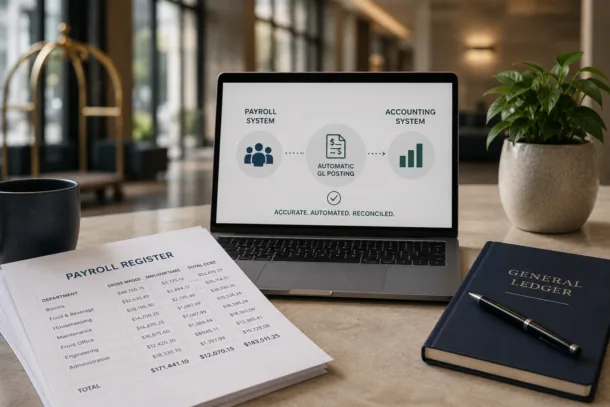
Hotel payroll integrates with accounting by automatically posting wage costs to the correct general ledger accounts and department codes after each payroll run. This eliminates manual journal entries, keeps department P&Ls current, and creates a reconcilable audit trail between payroll records and the GL.
Key Takeaways
- Payroll and accounting must be connected for department P&Ls to reflect accurate labor costs without manual intervention.
- The integration works by mapping each payroll expense category to a specific GL account and department code.
- When the integration is automatic, journal entries post immediately after payroll is processed — no manual step required.
- Reconciling payroll to the GL is straightforward when both systems share the same data; it is time-consuming when they do not.
- The three-way connection of labor management, payroll, and accounting is the most complete integration for hotel financial operations.
Every time a hotel processes payroll, a financial event occurs that must be recorded in the general ledger. Wages are an expense that belongs in specific GL accounts and specific department cost centers. In most hotel operations, that recording is either done automatically by an integrated system or manually by a controller. Hotel payroll software that integrates with accounting eliminates the manual step and ensures that the GL reflects accurate labor costs the moment payroll is processed.
Why Payroll and Accounting Must Connect
The general ledger is the authoritative financial record of the business. Every expense, including labor, must eventually be recorded there. When payroll and accounting are disconnected systems, the path from payroll to the GL runs through a manual process: a controller receives the payroll register, prepares journal entries for each wage category and department, and posts those entries to the GL.
This manual process has several failure points:
- Journal entries can be coded to the wrong GL account
- Department allocations can be incorrect if the payroll register is not organized by cost center
- The timing of manual entry means the GL may not reflect payroll expenses until days after the payroll run
- Reconciliation between the payroll register and the GL requires manual cross-referencing that takes hours
- When payroll corrections are made, the manual journal entry process must be repeated
Integration removes every one of these failure points by automating the payroll-to-GL posting process.
What Data Flows From Payroll to Accounting
The payroll-to-accounting data flow includes the following categories:
- Gross wages by employee, department, and payroll period
- Employer payroll taxes (FICA, FUTA, SUTA) by department
- Employee deductions (health insurance, retirement, garnishments)
- Employer benefit contributions
- Tip credits and tip income allocations for tipped employees
- Accrued vacation and PTO costs where applicable
Each of these data points must be mapped to a specific GL account and a specific department code so that the resulting journal entry accurately represents the cost structure of the payroll period.
Department Wage Allocation
In hotel accounting, wages do not flow to a single ‘labor expense’ account. They flow to specific accounts within specific department P&Ls. A housekeeper’s wages belong in the rooms department. A restaurant server’s wages belong in food and beverage. A front desk agent’s wages belong in rooms. An engineer’s wages belong in maintenance.
When a labor management system tracks not only hours worked but which department those hours belong to, that department attribution flows through payroll to the accounting system. The result is that each department P&L reflects its actual labor costs without any manual intervention.
Employees who work across departments in a single period — a common occurrence in full-service hotels — must have their wages split accordingly. Payroll systems that handle split department allocation simplify a coding task that would otherwise require significant manual effort.
How Journal Entries Are Posted
When payroll and accounting are integrated, the journal entry process works as follows:
- Payroll is finalized and approved in the payroll system
- The payroll system generates a journal entry file mapped to the hotel’s GL account structure
- The journal entry posts automatically to the accounting system
- Department P&Ls update immediately to reflect the new payroll expense
- The controller reviews the posting and confirms it reconciles to the payroll register
The hotel accounting platform receives the journal entry and applies it to the correct period. If payroll crosses a period boundary — a payroll run that includes days from two different accounting months — the integration should handle the allocation correctly rather than posting the entire amount to one period.
Best-in-class integrations also allow the controller to review the proposed journal entry before it posts, providing an approval step that catches any mapping errors before they enter the ledger.
How to Reconcile Payroll to the General Ledger
Even with an integrated system, periodic reconciliation between payroll records and the GL is a sound control practice. The reconciliation process should confirm:
- Total wages posted to the GL equal total gross wages in the payroll register for the period
- Payroll tax liabilities in the GL match the tax amounts calculated in the payroll system
- Department-level wage costs in the GL match the department allocations from the payroll register
- No duplicate postings occurred from system or process errors
- Employer benefit contributions in the GL align with payroll deduction records
With an integrated system, this reconciliation takes minutes because both systems use the same data. Without integration, it can take hours because it requires manual comparison of two independently maintained records.
What Integration Requires
Successful payroll-to-accounting integration requires several technical and operational prerequisites:
- A mapped GL account structure in the payroll system that matches the hotel’s chart of accounts
- Department codes in the payroll system that match the department codes in the accounting system
- A defined mapping for each payroll expense category to its corresponding GL account
- A process for handling payroll corrections and ensuring correcting entries post correctly to the GL
- Consistent period alignment between payroll cycles and accounting periods
Integration is most straightforward when both payroll and accounting are on the same platform, because the mapping is built into the system rather than maintained across two independent platforms. When payroll and accounting are separate products from different vendors, integration requires ongoing maintenance of the mapping and a more complex reconciliation process.
The strongest payroll-accounting integration is the one that requires the least manual intervention. Every step a controller must take manually is an opportunity for error and a cost to the close process.
How Inn-Flow Integrates Payroll and Accounting
Inn-Flow’s hotel payroll software and accounting modules are built on a shared data platform. When payroll is processed, journal entries post automatically to Inn-Flow’s general ledger using the property’s configured GL mapping. Department P&Ls update immediately. Reconciliation between payroll and the GL is automated.
The full three-way integration — labor management, payroll, and accounting — means that hours worked flow to payroll automatically, and wage costs flow to accounting without manual journals. Controllers focus on review and control rather than data entry.
Contact Inn-Flow to see how integrated payroll and accounting works in practice for hotel management companies.
Frequently Asked Questions
What is a payroll journal entry in hotel accounting?
A payroll journal entry is a GL transaction that records wage costs, payroll tax liabilities, and benefit contributions from a payroll run. It debits the appropriate wage expense accounts by department and credits the corresponding liability accounts (wages payable, taxes payable) and cash when paid. In an integrated system, this entry is generated and posted automatically.
Why does payroll need to be allocated by department in hotels?
Hotel P&Ls are organized by department — rooms, food and beverage, administration, engineering. Each department’s profitability depends on its revenue minus its expenses, including labor. If payroll costs are not allocated correctly by department, every department’s P&L will be inaccurate and management cannot rely on departmental financial statements for decision-making.
What happens when payroll and accounting periods do not align?
When payroll periods span two accounting months, wages must be accrued to the correct month. This requires either the payroll system or the accounting system to split the wage cost across both periods. Without integration, this accrual is a manual journal entry. With integration, it should be handled automatically by the system.
How often should payroll-to-GL reconciliation be performed?
Reconciliation should be performed every payroll cycle — weekly or bi-weekly depending on the payroll frequency. Waiting until month-end to reconcile payroll to the GL allows errors to compound across multiple pay periods and makes correction significantly more difficult.
Can payroll integration work across multiple hotel properties?
Yes — multi-property payroll-to-accounting integration is a standard requirement for hotel management companies. The payroll system must track which property each employee worked at in each period, and the journal entries must post to the correct property’s general ledger. Platforms designed for hotel management companies handle this multi-entity structure natively.