Building a hotel budget is one thing. Sticking to it is another.
Even the most carefully constructed budget can unravel over the course of a year. Inevitably, unexpected expenses arise, vendor prices fluctuate and purchasing decisions happen across departments, often without a clear picture of how much money is actually available.
The challenge isn’t necessarily poor planning. It’s the disconnect between the budget and the everyday decisions that determine whether it holds up.
In our September webinar, Protect the Plan: Smarter Hotel Purchasing Before the Money Is Spent, Inn-Flow’s Kyle Summers and Victoria Westnedge explored how connecting accounting and procurement can help hotel teams close that gap, turning budgets from static financial plans into practical tools for managing spend.
Here’s what that looks like in practice.
The Problem With Managing Spend After the Fact
For many hotel operators, the monthly P&L is where budget problems become visible. But by the time an expense shows up in a financial report, the purchasing decision behind it has already been made.
That creates a fundamental challenge: You can’t prevent overspending with information that arrives after the money has been committed.
Traditional purchasing workflows often leave teams working with incomplete information. A department manager may know their monthly budget but not have visibility into pending purchase orders, recent expenses, or changes to the forecast.
The result? A purchase that appears to be within budget today can contribute to an unexpected overage tomorrow.
The solution isn’t simply more reporting. It’s making financial information available earlier, when purchasing decisions can still be adjusted.
A Budget Is Only as Useful as the Information Behind It
Knowing your original budget isn’t the same as knowing what you can afford to spend.
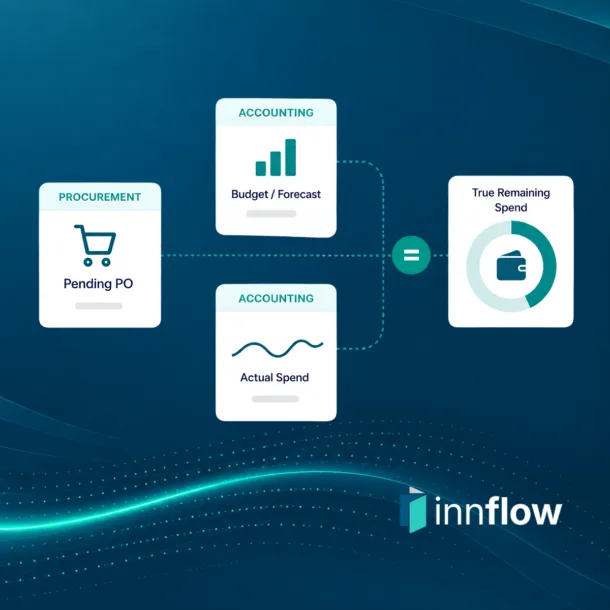
Consider a department with a $5,000 budget. If $1,850 has already been recorded in Accounting and another $2,300 is committed through pending purchase orders, the amount truly available is just $850.
Without visibility into both actual and committed expenses, a purchasing manager could easily overestimate what’s left.
This is where connected accounting and procurement make a meaningful difference.
By bringing budgets, forecasts, actual expenses, and pending purchase orders together, hotel teams can understand their true remaining spend rather than relying on a budget figure that tells only part of the story.
And because financial conditions change, that visibility needs to change with them. When forecasts are updated in Accounting, those changes should be reflected in the purchasing process without requiring teams to manually reconcile information between systems.
The goal is a shared, current understanding of available spend across the people planning the budget and the people making purchases against it.
Better Purchasing Decisions Don’t Have to Mean More Work
Of course, visibility only matters if teams can put it to use.
Hotel purchasing is already a balancing act. General managers and department leaders are managing operational demands, coordinating vendors, responding to unexpected needs, and trying to keep costs under control.
Adding more spreadsheets, approval emails, or manual budget checks isn’t necessarily the answer.
Instead, financial guardrails should be part of the purchasing workflow itself.
With Inn-Flow’s connected Accounting and Procurement solutions, buyers can see how items in their cart affect their available budget before placing an order. Visual indicators highlight when spending approaches or exceeds budget, while configurable approvals provide an additional layer of oversight when needed.
But staying within budget isn’t just about knowing when to stop spending. It’s also about finding opportunities to spend more efficiently.
For example, a purchaser may have a preferred vendor for guest supplies without realizing that another vendor offers the same product at a lower price. Comparing those options manually takes time, especially when shipping costs and order minimums come into play.
Inn-Flow’s Cart Optimizer helps simplify that process by identifying comparable products across vendors and evaluating opportunities to reduce the overall cost of an order.
Together, these capabilities help shift purchasing from a reactive process to a more informed one, without requiring hotel teams to become financial analysts every time they place an order.
Protecting the Plan Is an Ongoing Process
A hotel budget shouldn’t become irrelevant the moment it’s approved.
It should inform decisions throughout the year, adapting as forecasts change, expenses accumulate, and operational priorities evolve.
That was the central message of September’s Protect the Plan webinar: Better budget control doesn’t begin with the month-end review. It begins with the next purchasing decision.
By connecting the financial plan to the purchasing process, hotels can give teams the visibility and tools they need to make those decisions with greater confidence.
And as purchasing workflows become more connected, the opportunities extend beyond budget visibility alone. Inn-Flow also previewed its upcoming Inventory module, designed to help teams track stock levels, identify items running low, and reduce unnecessary last-minute purchases.
See Smarter Hotel Purchasing in Action
Want a closer look at how connected Accounting and Procurement help hotel teams protect their budgets?
Watch the full Protect the Plan webinar →
Or request a demo to see how Inn-Flow can help your properties make more informed purchasing decisions.