Hotels have no shortage of data. Occupancy. Revenue. Labor costs. Purchase orders. Invoices. Budgets. Forecasts. Property-level performance. Portfolio-level performance. The list goes on.
Over the past decade, hotel technology has become increasingly good at capturing, organizing, and reporting that information. Operators and finance teams can see more about their businesses than ever before.
A variance identified after month-end can be explained. A labor issue discovered after the schedule has already been played out can be analyzed. An unexpected expense that becomes visible once it reaches the P&L can be reported.
All of that information may be accurate, but the question is whether it arrived soon enough to actually act on.
As hotels think about the next generation of back-office technology, that may be the most important measure of useful data: not simply what can we see, but what can we still do about it?
The problem isn’t a lack of information
For years, one of the primary jobs of business software has been to make information easier to access.
That’s been enormously valuable. Hotel teams need reliable financial statements, labor reporting, purchasing records, forecasts, and performance dashboards. Without visibility into what’s happening across the business, better decisions simply aren’t possible.
However, as the number of systems and reports has grown, another challenge has emerged. The information needed to understand a decision may exist, but not necessarily in the same place—or at the same time—as the decision itself.
A finance leader may be able to identify an unusual expense, but only after reviewing a report. An operator may have access to labor data but still receive the signal too late to change the schedule. A property team may capture information throughout the month that doesn’t become meaningful until finance brings it together at close.
In each case, although the data exists, the distance between the data is a limiting factor.
Good data becomes more valuable when it arrives earlier
Consider labor.
A hotel may have detailed reporting on scheduled hours, actual hours, labor costs, and property performance. That information can tell a finance or operations leader a great deal about what happened during a given week or month.
But the same information becomes considerably more useful when it reaches managers while they can still adjust a schedule. Instead of identifying a labor issue after the fact, the team has information it can use while the outcome is still taking shape.
The underlying data hasn’t suddenly become more accurate because it’s being used earlier. It has become more actionable.
And the same principle extends across the hotel back office.
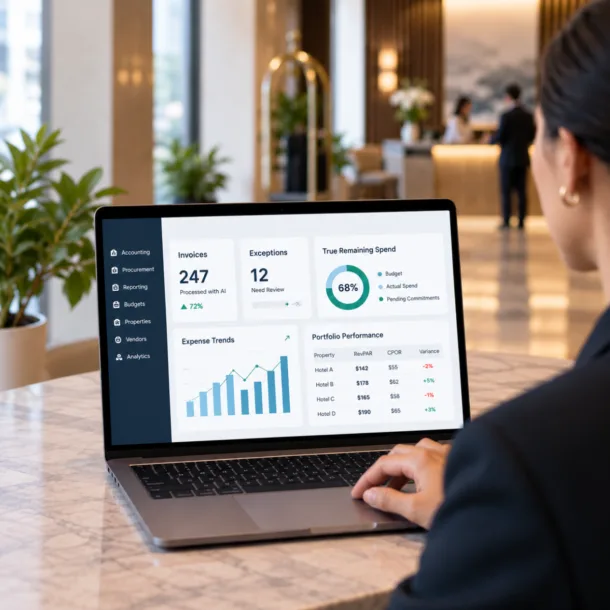
A financial exception is more useful when it surfaces early enough to investigate rather than discovered during a later review. An invoice becomes easier to act on when its information enters the workflow without waiting for someone to manually key every field. A forecast becomes more useful when current information can sharpen the picture of where the business is heading.
Useful data must reach the workflow
Hotel decisions rarely happen inside a report. They happen when a manager builds a schedule; a finance team reviews an exception, an AP team processes an invoice, or an ops leader adjusts a forecast. The information that shapes those decisions often comes from somewhere else in the business.
Each piece of information can be accurate on its own. What matters is whether it reaches the workflow where it can influence what happens next.
That’s one of the opportunities created by a more connected hotel back office. Integrations can move information between separate systems, but the depth and timing of that exchange can vary depending on how those systems are connected. A native platform integration allows data to move directly between workflows built within the same system.
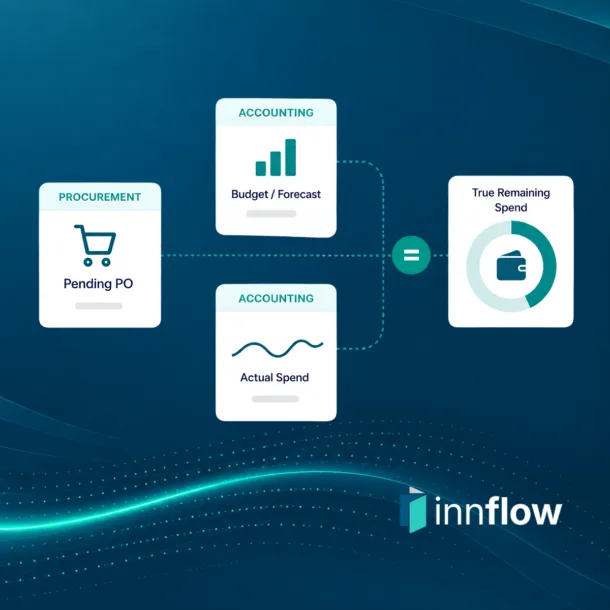
For Inn-Flow, that means Accounting, Labor, Payroll, Procurement and Business Intelligence can share information across the back office without hotel teams continually pulling reports, comparing systems, or assembling the relevant information themselves. Our native Accounting and Procurement integration is one example: because both workflows live within Inn-Flow, information generated through purchasing can flow directly into the hotel’s financial workflow.
The result is a shorter path from information to action.
AI can shorten the distance between signal and action
Getting information to the right place is only part of the equation. Hotel teams still have to turn that information into something useful.
This is where AI can play a meaningful role. One of its most practical applications in the hotel back office is helping information move through workflows faster and bringing the right signals to someone’s attention while they can still act on them.
Sometimes that means reducing the manual work required to make information usable in the first place. Invoice extraction, for example, can capture key information from an invoice and prepare it for review rather than requiring someone to enter that data manually.
In other cases, AI can help someone act on information that’s already available. Inn-Flow’s Cart Optimizer, for example, can evaluate a buyer’s cart and surface more cost-effective alternatives while the order is still being built. The buyer remains responsible for the final decision, but the recommendation arrives when there’s still an opportunity to choose differently.
These are different applications of AI, but the underlying principle is the same: the value comes from moving useful information closer to the moment of action.
AI can help teams spend less time processing or reviewing everything themselves and more time focusing on what requires their attention.
From dashboards to decisions
Dashboards aren’t going away. Neither are reports, financial statements, or the retrospective analysis hotel teams rely on to understand performance.
Nor should they.
But the next opportunity for hotel technology is shortening the distance between data, context, signal, decision and action.
That means operational information reaching managers while they can still adjust a schedule, invoice data entering the workflow without requiring someone to manually capture every field, exceptions reaching finance without requiring someone to search for them first, and relevant information appearing inside the workflow where a decision is already being made.
The question shifts from What does the data tell us happened? to What does the data allow us to do now?
That is a much higher bar for hotel technology and a much more useful one.
Hotels have spent years getting better at collecting and reporting data. Now the opportunity is to make that data work harder by connecting it to the decisions that shape what happens next.