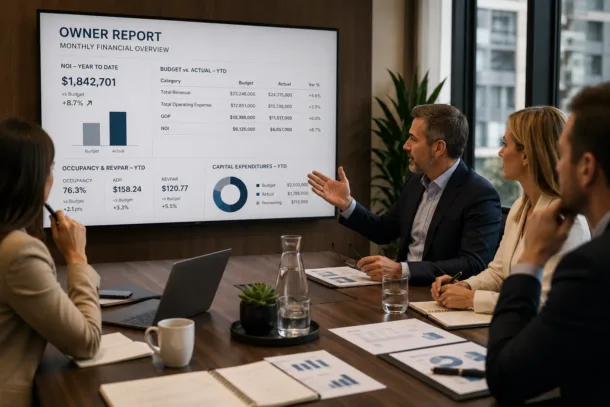
Hotel owners expect monthly financial reporting packages that include a USALI-compliant P&L, budget vs. actual variance with explanations, occupancy and rate statistics, capital expenditure tracking, and a management commentary. Packages should be delivered within 10 days of month-end.
Key Takeaways
- Ownership reporting expectations have increased as hotel owners have become more financially sophisticated.
- The standard reporting package includes P&L, budget vs. actual variance, RevPAR statistics, labor cost summary, and CapEx tracking.
- Timing matters as much as content — late reporting signals operational dysfunction.
- Format and clarity affect how owners perceive reporting quality, not just accuracy.
- Management companies that exceed reporting expectations gain a durable competitive advantage in owner retention.
Hotel owners invest significant capital in properties they do not manage day to day. Their primary window into how that capital is being stewarded is the financial reporting their management company provides. Understanding what owners actually expect — not just what management companies think they expect — is essential to building the kind of ownership relationship that sustains long-term contracts. This article lays out those expectations clearly.
The hotel accounting platform a management company uses determines how efficiently and accurately those reports can be produced. Ownership-quality reporting starts with ownership-quality accounting.
What Owners Are Trying to Understand
Before discussing specific report components, it is worth understanding the questions owners are trying to answer with financial data. Every report element should serve one or more of these questions:
- Is the property generating the NOI we projected when we acquired or budgeted this asset?
- Where is performance ahead of or behind plan, and why?
- Is the operator controlling costs effectively — particularly labor?
- Are there any capital issues that require attention or could affect future value?
- Is the property positioned to sustain or improve performance in future periods?
- Can I rely on these numbers to make decisions about refinancing, capital investment, or sale?
Owners who cannot quickly answer these questions from the reporting they receive are either calling their asset manager to dig for data or starting to question whether they have the right operator.
The Standard Hotel Owner Reporting Package
Monthly P&L Statement
A USALI-compliant Profit and Loss statement showing total revenue, departmental revenues and expenses, undistributed operating expenses, GOP, management fees, fixed charges, and NOI. Current month and year-to-date figures should both be present.
Budget vs. Actual Variance
Every significant line item compared to the approved annual budget, with a variance column and a management commentary explaining the most material departures from plan. Owners should not have to ask why costs were over or under budget.
Prior-Year Comparison
Current month and YTD figures compared to the same period in the prior year. This context allows owners to assess whether current performance represents improvement, stability, or decline independent of budget comparisons.
RevPAR and Occupancy Statistics
Occupancy percentage, ADR, and RevPAR for the current month and YTD, compared to budget and prior year. Some packages also include competitive set benchmarking from STR or similar sources if the owner subscribes to those services.
Labor Cost Summary
Total labor expense and labor cost percentage by department, compared to budget. For many owners, labor cost is their primary indicator of operational efficiency.
Capital Expenditure Tracking
Actual CapEx spend versus approved budget, reserve for replacement balance, and a forward-looking summary of known or anticipated capital needs. Owners who are surprised by capital calls develop lasting skepticism about the quality of their operator’s planning.
Balance Sheet and Cash Position
A current balance sheet and a cash position summary. Owners with debt-financed properties need to ensure sufficient cash is available for debt service. Those with equity-financed properties want to understand working capital dynamics.
Management Commentary
A brief written narrative from the GM or regional director explaining material variances, operational highlights, challenges encountered, and forward-looking context. Numbers without narrative leave owners to draw their own conclusions, which is rarely in the operator’s interest.
Timing Expectations
Ownership groups typically expect monthly reporting packages within 10 business days of month-end. Some sophisticated owners push for 7-day turnarounds. The minimum acceptable standard in most management contracts is 15 business days.
Management companies that consistently deliver within 10 days demonstrate a close process that is well-organized and well-staffed. Those that routinely deliver at or past 15 days signal either accounting inefficiency or understaffing — both of which raise questions that go beyond reporting.
The speed of the close process depends on how current the underlying books are. Bookkeeping that is maintained daily throughout the month means month-end is primarily a verification and review exercise, not a catch-up exercise. Properties where bookkeeping is done in weekly or monthly batches will always struggle to meet tight reporting timelines.
Format Preferences
Owners differ in their format preferences, but some patterns are consistent. Most prefer receiving a structured PDF package alongside access to the underlying data. Increasingly, sophisticated ownership groups also want access to business intelligence dashboards that allow them to explore current performance data between monthly deliverables.
Common format preferences include:
- Executive summary page at the front of the package with headline metrics (NOI, RevPAR, labor %) and management commentary
- Consistent layout from month to month so owners can navigate the package without re-learning it
- Graphs and trend charts alongside tabular data
- Property-level detail for individual assets and a consolidated view for multi-property ownership groups
- Digital delivery with searchable PDFs and underlying Excel files available on request
What Happens When Reporting Falls Short
When management companies miss reporting expectations — whether on timing, accuracy, or clarity — the consequences accumulate. Initial frustration leads to increased scrutiny, which leads to more frequent ad-hoc requests, which creates more work for the accounting team, which further delays formal reporting. It is a cycle that is easier to prevent than to reverse.
Owners who lose confidence in their operator’s reporting often begin exploring alternatives. In competitive management markets, reporting quality is one of the most common reasons ownership groups cite when they make management changes.
The most serious consequence of reporting failure is when an owner discovers an error after a financial decision has been made — a refinancing based on overstated NOI, or a capital allocation based on understated costs. At that point, the relationship rarely survives.
Differentiation Through Reporting Quality
Management companies that go beyond the minimum reporting standard gain a meaningful competitive advantage. Differentiation opportunities include:
- Delivering packages 3-5 days ahead of the expected window
- Proactively communicating material variances before the formal package is due
- Providing quarterly business reviews that include trend analysis and forward planning
- Offering owner-facing BI dashboard access for real-time performance monitoring
- Producing CapEx planning documents that connect future capital needs to current financial performance
The management companies that win long-term owner relationships are not always the ones producing the best operating results. They are often the ones whose reporting makes owners feel most informed and most confident.
How Inn-Flow Supports Hotel Owner Reporting
Inn-Flow’s integrated platform is designed to make ownership-quality reporting achievable for management companies of every size. hotel accounting software, automated close tools, and business intelligence reporting combine to produce accurate, on-time ownership packages without the manual effort that delays most reporting processes.
Management companies using Inn-Flow can produce USALI-compliant P&Ls, budget vs. actual reports, and portfolio summaries directly from the platform, with consistent formatting and automated data population.
Contact Inn-Flow to learn how the platform can elevate your ownership reporting quality and timeliness.
Frequently Asked Questions
What is the ideal reporting timeline for hotel ownership reports?
The target is 10 business days after month-end. Seven days is achievable with a well-organized close process and current bookkeeping. Fifteen days is the practical maximum before reporting timeliness becomes a concern for most ownership groups.
What should be in a hotel management commentary?
The management commentary should explain the most material budget variances, summarize operational highlights and challenges, provide context for revenue and cost trends, and offer a brief forward-looking perspective on the next period. It should be brief — typically one page or less — and focused on what owners need to understand, not on operational detail they do not need.
Should hotel owners have access to real-time financial data?
Providing owners with read-only dashboard access to current property performance is increasingly a differentiating capability for management companies. It reduces ad-hoc reporting requests, increases transparency, and shifts the relationship dynamic toward continuous partnership rather than periodic accountability.
What is the most common owner complaint about hotel financial reporting?
Late delivery is the most frequently cited complaint. Accuracy issues are a close second. Owners who receive timely, accurate reports rarely complain about format or presentation. Those who receive late or inaccurate reports tend to scrutinize everything else about their operator more closely.
How does hotel accounting software affect reporting quality?
Accounting software determines how efficiently transactions are captured, coded, and organized throughout the month. Systems that support USALI-compliant chart of accounts, automated reconciliation, and integrated reporting dramatically reduce the manual effort required to produce ownership packages and improve both timeliness and accuracy.