Hotel business intelligence software aggregates financial, operational, and labor data from across a property or portfolio and presents it in interactive dashboards, automated reports, and KPI scorecards. It replaces manual spreadsheet compilation with always-current visibility into performance drivers.
Key Takeaways
- BI software connects to accounting, labor, and PMS systems to consolidate data automatically.
- Unlike static reports, BI dashboards update in real or near-real time.
- Hotel management companies use BI to monitor performance across multiple properties from one interface.
- The value of BI depends on the quality and timeliness of the underlying data sources.
- Common outputs include NOI margin, RevPAR, labor cost percentage, and budget vs. actual variance.
Hotel operators collect enormous amounts of data every day. The challenge is not gathering that data but turning it into decisions quickly enough to matter. Hotel business intelligence software solves that problem by aggregating data from across the operation and surfacing it in dashboards, scorecards, and reports that show what is happening right now and how it compares to plan.
This article explains what hotel BI software is, how it differs from traditional reporting, where its data comes from, and how management teams use it to make faster and better decisions.
What Hotel Business Intelligence Software Does
At its core, hotel BI software connects to the data systems a property or portfolio already uses — the general ledger, the property management system, the labor management platform — and consolidates that information in a single environment. Instead of a controller exporting reports from multiple systems and compiling them in a spreadsheet, the BI platform does the aggregation automatically.
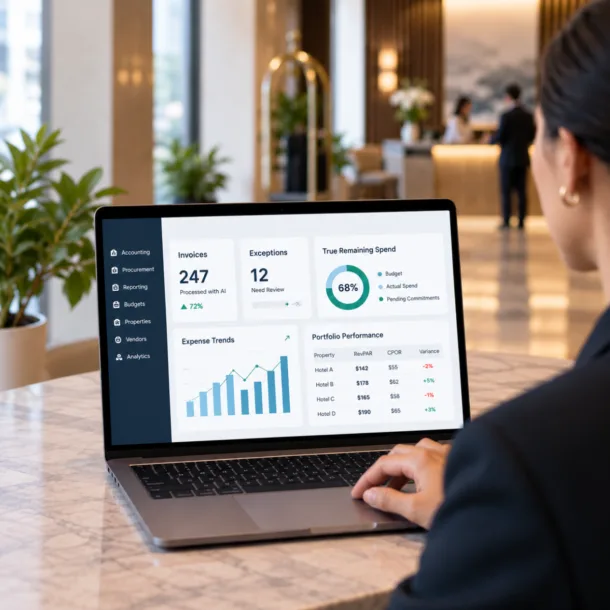
The result is a set of dashboards and reports that any authorized user can access without waiting for a monthly close or a weekly email from accounting. Owners see high-level performance. General managers see property-level details. Regional vice presidents see a portfolio view with drill-down capability.
Core functions include:
- Automated data ingestion from connected systems
- Configurable dashboards by role, property, or time period
- Budget vs. actual variance reporting
- KPI scorecards with trend lines
- Scheduled report delivery to stakeholders
- Drill-down from summary to transaction level
How Hotel BI Differs From Standard Reporting
Every accounting system produces reports. The difference between those reports and a BI platform lies in interactivity, timeliness, and integration.
Static Reports vs. Live Dashboards
A standard P&L report is a snapshot of a closed period. It tells you what happened. A BI dashboard pulls current data and lets users filter by date range, property, department, or cost category on demand. The same underlying data becomes more actionable when users can explore it rather than just read it.
Manual Compilation vs. Automated Aggregation
Traditional reporting in multi-property companies requires someone to collect reports from each property, normalize the data, and assemble a portfolio view. That process takes days and introduces error. BI software automates the aggregation so the portfolio view is always current.
Single System vs. Cross-System Visibility
A BI platform is designed to connect to multiple data sources simultaneously. Property management system revenue data, accounting ledger balances, and labor cost records all flow into the same environment, making cross-functional analysis possible.
Data Sources for Hotel Business Intelligence
The value of any BI platform depends on what it ingests. Hotel accounting is the primary data source because it contains the authoritative record of revenue, expenses, and profitability. A BI platform that connects directly to the general ledger can surface accurate P&L data without manual rekeying.
Other key data sources include:
- Property Management System (PMS): occupancy, ADR, RevPAR, reservation pace, and channel mix.
- Labor management: scheduled hours, actual hours, overtime, and labor cost by department.
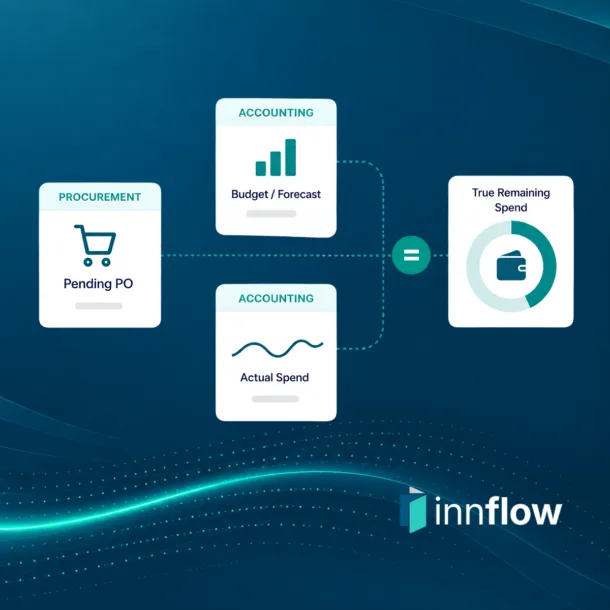
- Procurement: purchase order totals, vendor spend, and supply cost trends.
- Payroll: actual wage costs that reconcile against labor schedules.
The more sources a BI platform integrates, the more complete the picture it provides. Platforms that require manual imports create delays and introduce the same reconciliation risk that BI is supposed to eliminate. Connecting labor management data directly into BI dashboards is especially valuable because labor is typically the largest controllable cost in any hotel operation.
Key Features to Look For
Role-Based Access and Custom Views
Different users need different data. Owners want NOI and portfolio yield. GMs want department-level cost control. Controllers want reconciliation tools. A well-designed BI platform lets each role see what is relevant without exposing unnecessary detail.
Budget vs. Actual Tracking
Perhaps the most common use case in hotel finance is comparing actual performance against the approved budget. BI dashboards should show this variance by line item, by department, and by property, updated automatically as accounting data posts.
Multi-Property Consolidation
For management companies, the ability to view a consolidated portfolio alongside individual property detail is essential. Properties should be filterable and comparable, with consistent chart-of-accounts mapping that makes cross-property benchmarking meaningful.
KPI Scorecards
Key metrics like NOI margin, RevPAR, labor cost percentage, and GOP PAR should be visible at a glance, with trend lines that show direction and contextual comparisons to budget, prior year, or portfolio average.
Scheduled Report Delivery
Not every stakeholder logs into a dashboard. Automated report delivery — daily, weekly, or monthly — ensures that ownership groups and executives receive the information they need without relying on manual distribution.
Who Uses Hotel Business Intelligence
Hotel Management Companies
Multi-property operators are the primary users of hotel BI. They use it to monitor portfolio performance, identify underperforming assets, prepare ownership reports, and support budget and forecast processes.
General Managers
GMs use property-level dashboards to track daily revenue, monitor labor costs against schedule, and respond to variances before they compound into monthly problems.
Controllers and CFOs
Finance leaders use BI to accelerate the close process, validate accounting accuracy, and produce the reporting packages that ownership groups require.
Ownership Groups and Asset Managers
Owners and their advisors use BI-generated reports to evaluate property performance, assess whether their operator is hitting plan, and make capital allocation decisions.
How BI Drives Better Decisions
The practical value of hotel BI is not in the dashboards themselves but in what those dashboards enable. When management teams can see accurate, current data without waiting for a manual report, several things change.
Labor cost overruns that would previously surface at month-end are visible within days. Revenue shortfalls against pace can trigger pricing or sales interventions while there is still time to recover. A property that consistently trails the portfolio average in GOP PAR becomes visible for targeted support or management review.
BI also changes the nature of ownership communication. Instead of presenting a monthly P&L with limited context, management companies can provide interactive access to performance data, budget comparisons, and trend analysis. That transparency builds confidence and strengthens long-term owner relationships.
The question hotel BI software answers is not ‘What happened last month?’ It is ‘What is happening now, what does it mean, and what should we do about it?’
How Inn-Flow Supports Hotel Business Intelligence
Inn-Flow’s business intelligence platform is built specifically for hotel management companies. It connects directly to Inn-Flow’s accounting, labor, and payroll modules, so dashboards reflect current data without manual imports or reconciliation delays.
Management companies use Inn-Flow BI to monitor portfolio performance, produce owner reporting packages, track budget vs. actual by property and department, and give GMs real-time visibility into the cost drivers they control.
Contact Inn-Flow to see how the platform supports financial visibility across your portfolio.
Frequently Asked Questions
What does hotel business intelligence software integrate with?
Most hotel BI platforms integrate with property management systems for revenue data, accounting systems for financial data, and labor management platforms for workforce cost data. The breadth of integration determines the completeness of the picture the platform can provide.
How is hotel BI different from a PMS reporting module?
A PMS reporting module shows revenue and operational data from the property management system. Hotel BI software goes further by integrating financial, labor, and procurement data alongside PMS data, enabling complete profitability analysis rather than revenue analysis alone.
How often does data in a hotel BI dashboard update?
Update frequency depends on the platform and its integrations. Best-in-class systems update continuously as accounting transactions post and labor data syncs. Others update daily or require scheduled imports. The goal is that dashboards reflect current operations rather than last week’s close.
Is hotel BI software useful for single-property operators?
Yes, though the multi-property consolidation features are less relevant. Single properties benefit from dashboard access, budget vs. actual tracking, and KPI visibility. The labor cost and profitability monitoring features are valuable regardless of portfolio size.
What data quality issues affect hotel BI accuracy?
Inconsistent chart-of-accounts coding, delayed transaction posting, and manual data entry errors in source systems all degrade BI accuracy. A BI platform cannot produce reliable output from unreliable input, which is why accounting and bookkeeping discipline is foundational to BI value.