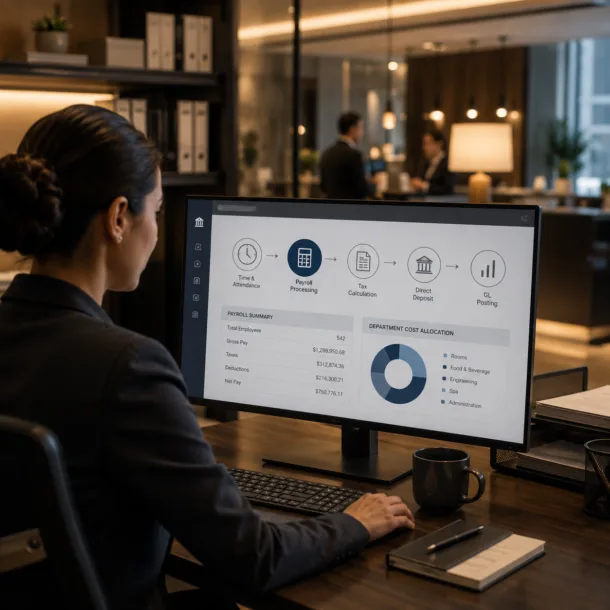
Hospitality payroll software processes wages, tip reporting, departmental cost allocation, and multi-state tax compliance for hotel operations. The best platforms integrate directly with labor management systems to receive time and attendance data, and with accounting systems to post wage costs automatically to the general ledger.
Key Takeaways
- Hotel payroll is more complex than standard payroll because of tip reporting, tipped minimum wage calculations, high turnover, and multi-state tax obligations.
- The most important integration for hospitality payroll software is with labor management — time and attendance data should flow to payroll automatically.
- Payroll must also connect to accounting so wage costs post to the correct GL accounts and department codes without manual journal entries.
- Disconnected payroll systems create reconciliation problems, compliance risk, and inaccurate department P&Ls.
- Payroll errors in hotels are costly — both financially through correction payrolls and legally through wage compliance exposure.
Hotel payroll is not just a scaled-up version of general business payroll. The combination of tipped employees, variable-demand staffing, multi-state operations, and the need for department-level wage allocation makes hospitality payroll uniquely complex. Hospitality payroll software is designed to handle those complexities while integrating with the labor and accounting systems that hotel management companies depend on.
What Hospitality Payroll Software Does
At its core, hospitality payroll software calculates and processes employee wages, deductions, and taxes for one or more hotel properties. But the feature set required to handle hotel-specific needs goes well beyond basic payroll processing.
Core functions include:
- Wage calculation for hourly and salaried employees across multiple properties
- Tip reporting and tip credit calculations for tipped employees
- Tipped minimum wage compliance, including tip credit tracking by state
- Multi-state tax calculation and filing for management companies with properties in multiple states
- Department-level wage allocation so payroll costs post to the correct cost centers in the general ledger
- Deduction management including health insurance, retirement, garnishments, and voluntary benefits
- Payroll tax deposits and government filings (941, W-2, state equivalents)
- Direct deposit and pay stub distribution
- Payroll audit trails and reporting for internal and external review
What Makes Hotel Payroll Different
Tipped Employees and Tip Reporting
Hotels typically employ significant numbers of tipped workers — servers, bartenders, banquet staff, and sometimes housekeeping staff in tip-sharing arrangements. Tip reporting requires collecting declared tip amounts, calculating tip credits against the minimum wage where applicable, and ensuring that total compensation (base wage plus tips) meets minimum wage requirements.
States vary significantly in how they handle tipped minimum wages and tip credit allowances. A management company with properties in multiple states must navigate a patchwork of rules that change periodically.
Variable Staffing and High Turnover
Hotel staffing levels fluctuate with occupancy, seasonality, and events. The result is high employee turnover relative to most industries, frequent new-hire onboarding, and a payroll roster that changes significantly from period to period. Payroll systems that make employee setup and termination efficient are essential.
Multi-State Tax Complexity
A management company operating properties in five or ten states faces five or ten different state income tax systems, unemployment tax rates, and local tax requirements. Keeping current with these requirements manually is impractical. Payroll software that handles multi-state compliance automatically reduces both the administrative burden and the compliance risk.
Department-Level Cost Allocation
Hotel P&Ls are organized by department: rooms, food and beverage, spa, engineering, administration. Payroll costs must be allocated to the correct department so that each department’s P&L reflects its true labor expense. This requires payroll software to track not just the employee’s wage but which department(s) they worked in each period.
Key Features of Hospitality Payroll Software
Time and Attendance Integration
The most operationally important feature of hospitality payroll software is its connection to the labor management system. When employees clock in and out using the property’s time and attendance system, that data should flow to payroll automatically. Manual time entry is a source of error and is particularly problematic in hotel environments where scheduling changes frequently.
Multi-Property Payroll Processing
Management companies need to process payroll across multiple properties simultaneously, with each property’s wage costs correctly attributed to that property. Payroll software that handles multi-property consolidation reduces administrative overhead and improves accuracy.
Compliance Management
Payroll software should track applicable minimum wage rates, overtime rules, and tax rates for every jurisdiction where the company employs workers and update those parameters automatically as regulations change.
Reporting and Audit Capability
Payroll registers, department-level cost summaries, tax liability reports, and year-end filings should all be accessible from the payroll system without manual assembly. Audit support — the ability to produce documentation for a specific pay period at any time — is particularly important for management companies with multiple ownership groups.
Integration With Labor Management
The payroll-to-labor connection is the highest-value integration in hotel workforce management. Labor management systems track employee schedules, actual hours worked, and department assignments. When that data flows automatically to payroll, the payroll period becomes a validation exercise rather than a data entry exercise.
This integration eliminates a category of errors that are common in hotel payroll:
- Hours entered in payroll that do not match time clock records
- Department codes assigned incorrectly during manual payroll entry
- Overtime hours missed because the payroll processor did not have visibility into the full schedule
- New employees paid in the wrong period because time-and-attendance and payroll systems were not synchronized
Integration With Accounting
After payroll is processed, wage costs must be posted to the general ledger. Hotel accounting integration means that payroll journal entries are generated and posted automatically, with wage costs allocated to the correct GL accounts and department codes. This eliminates manual journal entry and ensures that department P&Ls reflect accurate labor costs immediately after each payroll run.
The payroll-to-accounting connection also enables:
- Payroll reconciliation to the GL without manual cross-referencing
- Accurate labor cost percentages in real-time financial dashboards
- Audit-ready payroll expense documentation tied directly to GL transactions
What Happens When Payroll Is Disconnected
Hotels that operate payroll in isolation from their labor management and accounting systems pay a significant operational tax. The symptoms include:
- Payroll processors manually entering time data from time clock systems — creating re-keying errors and adding hours to every payroll cycle
- Controllers manually entering payroll journal entries after each payroll run — adding hours and introducing coding errors
- Department P&Ls that do not reflect correct labor costs until manual journals are posted, often days after payroll
- Reconciliation discrepancies between payroll records and the general ledger that take hours to diagnose and resolve
- Compliance gaps from applying outdated tax rates in one system that have already been updated in another
Disconnected payroll is not just an inconvenience — it is a source of continuous operational friction and compliance risk that compounds across every pay period.
How Inn-Flow Handles Hospitality Payroll
Inn-Flow’s hospitality payroll software is built for hotel management companies and integrates natively with Inn-Flow’s labor management and accounting modules. Time and attendance data flows directly to payroll. Payroll journal entries post automatically to the GL. Department-level wage costs appear in financial dashboards without manual intervention.
The result is a payroll process that is accurate, compliant, and connected — without the reconciliation overhead that standalone payroll systems require.
Contact Inn-Flow to see how integrated payroll works for hotel management companies.
Frequently Asked Questions
What makes hotel payroll more complex than standard payroll?
Hotel payroll involves tipped employee reporting and tip credit calculations, multi-state tax compliance, variable-demand staffing that changes frequently, high employee turnover, and the requirement to allocate wage costs by department for accurate P&L reporting. Each of these adds complexity that standard payroll systems are not designed to handle.
How does tip reporting work in hotel payroll software?
Employees declare tip income, which the payroll system records against their wages. The system then calculates whether total compensation (base plus tips) meets the applicable minimum wage. Where tip credits are allowed by state law, the system applies the credit and adjusts the base wage accordingly. Year-end W-2 reporting includes both wages and tips.
What is department-level wage allocation in hotel payroll?
Department-level wage allocation assigns each employee’s wages to the department or departments where they worked in a given period. A server who works in both the restaurant and banquet operations in the same week should have their wages split across both department codes. This allocation drives accurate department P&L reporting.
Does hospitality payroll software handle multi-state tax compliance?
Yes — that is one of the primary requirements for hotel management companies with properties in multiple states. Payroll software should track applicable state income tax rates, unemployment tax rates, and local tax requirements for each property location and update them automatically as regulations change.
What should hotels look for when selecting payroll software?
The most important evaluation criteria are: native integration with the labor management system, native integration with the accounting system, multi-state compliance capability, department-level cost allocation, tip reporting and tipped minimum wage compliance, and multi-property payroll processing. Generic payroll platforms often lack the hospitality-specific features that make hotel payroll manageable at scale.