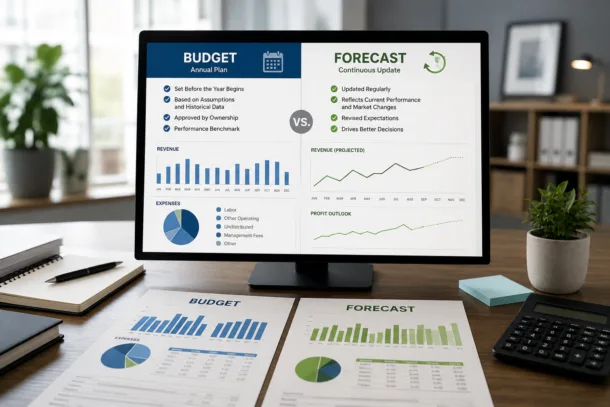
A hotel budget is an approved annual financial plan set before the year begins. A hotel forecast is a continuous update that reflects current performance and revised expectations. Both are necessary — the budget provides the benchmark, and the forecast tells you where you are actually headed given what is known today.
Key Takeaways
- Budgeting and forecasting are related but distinct processes that serve different purposes.
- The budget is approved once and becomes the year’s performance benchmark.
- Forecasting updates continuously as actual results and market conditions evolve.
- Labor is typically the largest expense in a hotel budget and the most forecastable variable cost.
- Neither budgeting nor forecasting is valuable if disconnected from accounting actuals.
Hotel management companies that confuse budgeting with forecasting often end up with neither done well. They produce an annual budget that becomes stale by February, and they produce point-in-time forecasts that are never accurate because they are not updated frequently enough. Understanding how these two tools differ — and how they must connect to accounting — is the starting point for building a financial planning process that actually supports decisions. Hotel accounting software that integrates directly with planning tools makes both budgeting and forecasting more accurate and less labor-intensive.
What Is a Hotel Budget
A hotel budget is a detailed financial plan for the upcoming fiscal year. It specifies expected revenue by source, planned expenses by department and category, and projected profitability metrics including GOP and NOI. It is built based on the best available information at the time of preparation and is approved by ownership before the year begins.
The budget serves several critical functions:
- It sets performance expectations that management is accountable to
- It communicates the operator’s plan to ownership and aligns both parties on financial targets
- It drives departmental expense limits and staffing plans
- It becomes the benchmark for budget vs. actual reporting throughout the year
Once approved, the budget does not change. That is both its strength and its limitation. It provides a stable reference point, but it cannot reflect market changes that occur after approval.
Budget Components
A complete hotel budget includes:
- Rooms revenue by month, based on projected occupancy and ADR
- Food and beverage revenue by outlet
- Other operated department revenue
- Department-level expense budgets with labor, supplies, and direct costs
- Undistributed operating expenses including sales and marketing, property operations, and utilities
- Management fees, property taxes, insurance, and reserve for replacement
- Capital expenditure plan and FF&E reserve
What Is a Rolling Forecast
A rolling forecast starts with the approved budget and updates it based on actual performance and revised expectations. Rather than treating January’s budget assumptions as valid in October, a rolling forecast continuously incorporates what has actually happened and what is now expected.
Rolling forecasts are typically updated:
- Monthly for most management companies — the forecast is updated after each close with actual results and revised projections
- Weekly during high-demand periods or when significant variance from budget has emerged
- Continuously on platforms where actual data flows in real time from accounting and labor systems
The value of the rolling forecast increases as update frequency increases. A forecast updated annually is barely more useful than the original budget. A forecast updated weekly can drive meaningful operational decisions.
How Budgeting Works in Practice
Hotel budget cycles typically begin three to four months before the fiscal year start. The process follows a structured sequence:
Revenue Assumption Development
The budgeting process begins with revenue projections. Historical occupancy, ADR, and RevPAR data provide the baseline. Market outlook, competitive set expectations, renovation impacts, and ownership input are layered on top. Revenue by month should reflect seasonal patterns specific to each property’s market.
Department-Level Expense Planning
Once revenue assumptions are set, each department builds its expense budget. Hotel labor management systems that connect to budgeting tools can generate staffing models based on projected occupancy and historical productivity ratios, making labor budgeting significantly more accurate than manual estimation.
Ownership Approval
The completed budget is presented to ownership for review and approval. Ownership groups typically want to see the budget alongside prior-year actuals, the current-year forecast, and the assumptions behind key projections. Approval by ownership establishes mutual accountability for the year ahead.
Loading Into Accounting
After approval, budget figures are loaded into the accounting system so that budget vs. actual reporting can begin. Accounting systems that accept budget data at the line-item and department level allow automated variance reporting throughout the year.
How Forecasting Works
Forecasting is an ongoing process that runs in parallel with accounting throughout the year. The core forecasting cycle works as follows:
- Actual results for the most recently closed period are reviewed against budget
- Revised revenue expectations are developed based on current pace, booking trends, and market conditions
- Labor and expense projections are updated based on the revised revenue outlook
- The full-year financial projection is updated to show where the property is expected to land vs. budget
- The updated forecast is communicated to management and ownership
Effective forecasting requires discipline. It is easy to allow the forecast to become optimistic — reflecting what management hopes will happen rather than what the data actually suggests. Forecasts built on realistic assumptions are more useful even when they deliver unwelcome projections.
Why Both Must Connect to Accounting
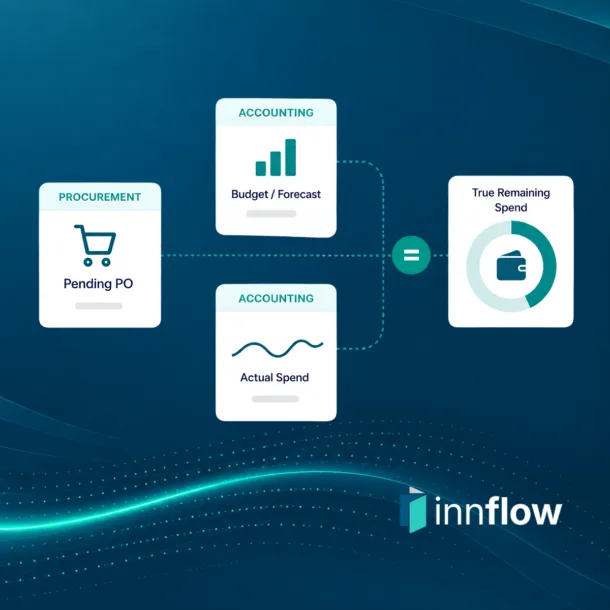
The connection to accounting is what gives both budgeting and forecasting their operational value. A budget loaded into the business intelligence platform alongside actual GL results produces the budget vs. actual variance reports that drive management accountability. A forecast that incorporates actual accounting data is significantly more accurate than one built from estimates and memory.
When accounting and planning are disconnected, budgeting becomes a theoretical exercise that does not drive behavior, and forecasting becomes a periodic estimate that no one updates because it takes too long.
The goal is a financial management cycle where:
- The budget is loaded into the accounting and BI systems before year-start
- Actual results post to accounting continuously throughout the period
- Budget vs. actual variance reports update automatically as the period progresses
- Forecasts incorporate actual data from the close and revised forward projections
- Ownership sees both current-period actuals and full-year projections in every reporting package
Common Budgeting Mistakes
- Building the budget from the top down without department-level input — resulting in expense targets that are unrealistic.
- Treating prior-year actuals as the only basis for projections without incorporating market context.
- Setting a budget that is approved but never loaded into the accounting system — making budget vs. actual reporting manual.
- Failing to update the forecast regularly enough to be actionable.
- Allowing optimism bias to make the forecast consistently more favorable than reality — which delays corrective action.
- Treating labor as a fixed cost in the budget rather than modeling it dynamically against revenue projections.
A budget that no one believes and a forecast that no one updates are not planning tools. They are compliance exercises. The goal is a process that people actually use to make decisions.
How Inn-Flow Supports Hotel Budgeting and Forecasting
Inn-Flow connects hotel accounting software, labor management, and business intelligence on a single platform — making the budget-to-actual feedback loop automatic. Approved budgets load directly into the system, actual results post from the GL in real time, and budget vs. actual variance reports are available on demand throughout the period.
Management companies using Inn-Flow can build department-level budgets, run rolling forecasts based on current actuals, and provide ownership with the plan-versus-performance visibility they expect.
Contact Inn-Flow to learn how the platform supports financial planning for hotel management companies.
Frequently Asked Questions
When should hotel budgeting start for the next fiscal year?
Most hotel management companies begin the budget process three to four months before the fiscal year start. For a January 1 fiscal year, budget preparation typically starts in September and concludes with ownership approval by mid-November, allowing budget data to be loaded into accounting systems before year-end.
How is a rolling forecast different from a revised budget?
A revised budget is a formal amendment to the original approved budget, typically requiring ownership approval. A rolling forecast is an operational tool that updates continuously without requiring formal approval. The original budget remains the accountability benchmark regardless of what the forecast shows.
How detailed should a hotel labor budget be?
The labor budget should be built at the department level at minimum, with positions and headcount assumptions visible. The most useful labor budgets are built from occupancy-driven staffing models that show how labor hours and costs scale with projected demand. This level of detail makes variance analysis meaningful throughout the year.
Should hotel ownership be involved in the budget process?
Yes. Owner involvement in the budget process — even if limited to reviewing and approving the final document — aligns expectations for the year and provides operators with a clear mandate. Ownership groups that have not approved the budget cannot fairly be held to it, and management companies that operate without ownership-approved budgets lack the accountability structure that professional property management requires.
What is the most common reason hotel forecasts are inaccurate?
Infrequent updates are the most common cause. Forecasts that are only updated monthly cannot capture the pace changes, market shifts, and operational developments that occur between updates. The second most common cause is disconnection from actual accounting data, which means the forecast is built from estimates rather than verified results.