Hotel portfolio reporting is the process of consolidating financial and operational data from multiple properties into a unified view that management companies and owners can use to evaluate performance, identify trends, and make investment decisions. It requires consistent data standards across all properties, a technology layer that aggregates and normalizes that data, and reporting formats designed for different audiences from property general managers to ownership groups.
Key Takeaways
- Portfolio reporting requires consistent account structures and data definitions across all properties before aggregation is meaningful.
- Property-level and portfolio-level reporting serve different audiences and different decisions.
- The accuracy of portfolio reports depends directly on the accuracy of daily bookkeeping at each property.
- Owners typically focus on RevPAR, GOP, and cash flow; management companies focus on operational and cost metrics.
- Technology that consolidates data automatically is essential for timely portfolio reporting across large property counts.
What Hotel Portfolio Reporting Covers
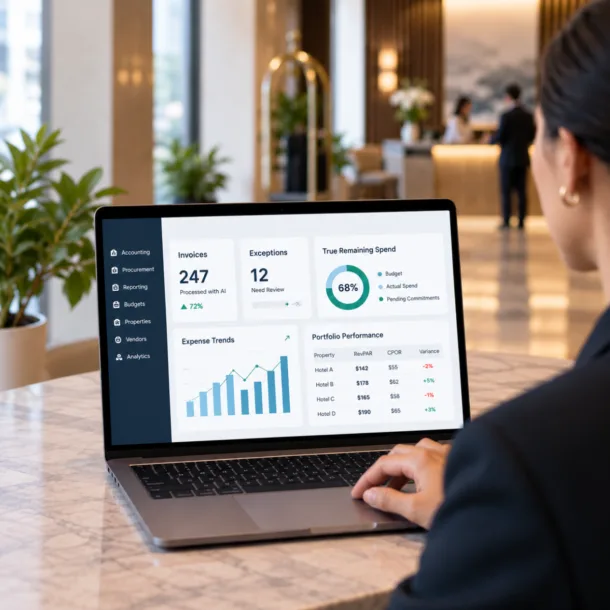
Hotel portfolio reporting consolidates the data that matters most to owners and management companies across all properties in the portfolio. A business intelligence platform built for hotel management companies aggregates this data automatically, so reports reflect current performance without requiring manual data assembly from each property.
Portfolio reports typically cover financial performance metrics — revenue, expense, and profitability — alongside operational metrics that provide context for the financial results. Rooms revenue and occupancy sit alongside food and beverage revenue. Labor costs are analyzed alongside RevPAR. GOP margin is compared across properties and to prior period and budget. The combination of financial and operational data is what makes portfolio reporting actionable rather than merely informative.
Management companies also track portfolio-level metrics that do not exist at the property level: average GOP across the portfolio, total managed revenue, portfolio-wide labor cost percentage, and aggregate accounts payable status. These portfolio-level indicators tell the story of the management company’s performance as a whole, not just the sum of individual property results.
Property-Level vs. Portfolio-Level Reporting
Property-level reporting serves the people responsible for operating each hotel: the general manager, department heads, and the owner of that specific property. It focuses on granular operational data — daily revenue by department, labor hours by cost center, purchasing activity by category, and occupancy patterns by day of week and booking channel. The audience needs enough detail to make operational decisions.
Portfolio-level reporting serves management company leadership and ownership groups who need to evaluate performance across all properties simultaneously. The detail is compressed; individual line items from a single property’s departmental schedule are less useful than the pattern across 20 properties. The questions being answered are different: which properties are outperforming, which are underperforming relative to market, where is labor cost running above benchmark, and what does the portfolio’s cash generation look like.
Effective reporting systems produce both levels without requiring separate data sources or manual consolidation. Property data rolls up automatically to the portfolio view, with drill-down capability that allows a reviewer to move from the portfolio summary to a specific property’s detailed results without changing tools.
How Portfolio Data Is Consolidated
The accuracy and completeness of portfolio reporting depends on consistent coding and definitions at the property level. When every property uses the same USALI-compliant chart of accounts and the same definitions for revenue categories, expense types, and statistical metrics, aggregation is straightforward. When properties use different structures, consolidation requires reclassification that introduces delay and errors. This is why hotel accounting software that enforces a consistent chart of accounts across all properties is foundational to reliable portfolio reporting.
Data consolidation in a modern hotel management platform happens automatically and continuously rather than through period-end batch processes. As transactions are posted at each property, they are immediately available in the portfolio view. This real-time consolidation means that management company leadership does not have to wait until each property’s month-end close to see portfolio performance trends.
Statistical data — occupied rooms, available rooms, RevPAR, ADR, occupancy percentage — is consolidated alongside financial data. This allows the portfolio view to show GOP per available room (GOPPAR) and labor cost per occupied room alongside the financial totals, giving the performance context that financial numbers alone cannot provide.
What Owners Look for in Portfolio Reports
Ownership groups invest capital into hotel portfolios and need financial reporting to evaluate the return on that investment. Their primary metrics are typically RevPAR and RevPAR growth relative to competitive set, GOP and GOP margin, net operating income (NOI), debt service coverage, and capital expenditure tracking relative to reserve. These metrics tell the owner whether the management company is extracting the expected revenue potential from each property and managing costs to protect GOP.
Owners also want exception reporting — a view of which properties are performing significantly above or below expectation — rather than line-by-line review of every property every month. A portfolio report that highlights the outliers in both directions, with context about what is driving the variance, is more useful for ownership decision-making than a comprehensive data dump that requires hours of analysis.
Timing matters significantly to ownership groups. Reports that arrive three weeks after month-end have limited decision-making value. Management companies that can produce reliable, preliminary reports within seven to ten days of month-end close demonstrate operational maturity that builds owner confidence.
The Role of Daily Bookkeeping in Portfolio Report Accuracy
Portfolio reports are only as accurate as the daily data that feeds them. If nightly audit figures are entered incorrectly, departmental revenue is miscoded, or invoices are posted to the wrong cost center, the portfolio report reflects those errors at scale. Bookkeeping accuracy at the property level is not just an accounting discipline — it is the foundation of management company credibility with owners who rely on portfolio reports to make investment decisions.
Management companies that invest in bookkeeping quality controls — daily review of exception reports, regular reconciliation of departmental revenue to PMS data, prompt resolution of coding errors — produce portfolio reports that ownership groups trust. Those that allow inaccuracies to accumulate spend disproportionate time correcting reports after the fact, often too late to inform the decisions the reports were meant to support.
Technology Requirements for Portfolio Reporting
Effective portfolio reporting at scale requires a technology stack that can aggregate data from multiple properties automatically, apply consistent definitions and calculations, and present results in configurable formats for different audiences. The core requirements are: a property accounting system that enforces consistent chart-of-accounts structures, a data layer that consolidates property data in real time, and a reporting and visualization layer that allows end users to navigate from portfolio summary to property detail without requiring IT support.
Point solutions that require manual data exports and consolidation in spreadsheets do not scale. At four or five properties they are merely inconvenient; at fifteen or twenty they are operationally unworkable. Management companies that are growing their portfolios need a technology foundation that scales with them, not one that creates increasing manual burden as the property count increases.
Common Failures in Hotel Portfolio Reporting
- Inconsistent chart-of-accounts structures across properties, making cross-property comparison require reclassification before it is meaningful.
- Delayed property reporting that makes portfolio data available weeks after the relevant operating decisions have already been made.
- Reports designed for one audience — typically the accounting team — that do not present information in a format useful for owners or property GMs.
- Statistical data tracked separately from financial data, preventing calculation of key per-available-room and per-occupied-room metrics.
- No exception reporting capability, requiring manual review of all properties to identify outliers.
How Inn-Flow Supports Hotel Portfolio Reporting
Inn-Flow’s business intelligence platform is built for hotel management companies that need portfolio-level financial and operational reporting across multiple properties. Consistent account structures, real-time data consolidation, and configurable reporting formats for different audiences are all included in one platform. Visit Inn-Flow Business Intelligence to learn more.
Frequently Asked Questions
How many properties does portfolio reporting become necessary?
Formal portfolio reporting structures become practically necessary as soon as a management company operates three or more properties with shared ownership or corporate oversight. At that scale, the management company needs to demonstrate that it can report on all properties consistently and efficiently. The sooner the structure is built, the easier it is to add properties without disrupting reporting.
What is the typical reporting cycle for hotel portfolio reporting?
Most management companies produce formal portfolio reports monthly, with daily or weekly operational dashboards for key metrics like occupancy, RevPAR, and revenue pace. Some ownership groups request weekly summary reports during peak periods or when specific performance issues are being monitored. Quarterly and annual summaries roll up the monthly data into longer-trend views.
How does portfolio reporting differ from consolidated financial statements?
Portfolio reporting is operational and management-focused, designed to inform operating decisions and ownership reviews. Consolidated financial statements are GAAP or IFRS accounting constructs that combine the legal entities of all owned properties. Many owner groups require both: portfolio reports for operational review and consolidated statements for financial reporting and tax purposes.
What data does portfolio reporting pull from the property management system?
Portfolio reporting typically pulls occupancy, ADR, RevPAR, room nights sold, room nights available, and revenue by room category from the PMS. This statistical data is combined with financial data from the accounting system — which records revenue, expenses, and departmental results — to produce the per-available-room and per-occupied-room metrics that give context to the financial figures.